


At the end of this article, you will be able to:
Medicines are essential to health, but their impact does not end once they are dispensed or taken by a patient. Medicines can affect the environment throughout their lifecycle — from manufacture to patient use to disposal. With life expectancy and global medicine use increasing, pharmaceutical pollution is a growing environmental concern.
Community pharmacists are uniquely placed at the interface between prescribing, medicine use and disposal, giving us a real opportunity to prevent and mitigate the environmental harm of medicines.
Healthcare itself has an environmental footprint, and medicines contribute substantially to both greenhouse gas emissions and environmental pollution. Globally, healthcare-related greenhouse gas emissions have increased by 36% since 2016, while pharmaceuticals account for approximately one-quarter of the NHS carbon footprint in the United Kingdom.
Human excretion is the largest route by which medicines enter the environment. Many medicines are not completely broken down by the body and are excreted into wastewater, where treatment plants may not fully remove their residues. Other sources include inappropriate disposal, pharmaceutical manufacturing and agriculture.
Image 1: How medicines enter the environment

Source: AI generated
As medicines are designed to be biologically active at low concentrations, and many biological targets are shared across species, residues can affect aquatic organisms and ecosystems. For example, oestrogens have been linked to feminisation of male fish, diclofenac to tissue damage in fish, and fluoxetine to altered fish behaviour.
While these medicines are clinically essential, their environmental presence highlights the importance of appropriate use, avoiding unnecessary supply and promoting safe disposal.
Antibiotics are of particular environmental concern because their presence in the environment can contribute to the development and spread of antimicrobial resistance (AMR). According to the European Centre for Disease Prevention and Control, Ireland ranked eighth highest among EU/EEA countries for community antibiotic consumption in 2024.
Antibiotics can enter wastewater following patient use, while inappropriate disposal of unused antibiotics, particularly liquid formulations, is an additional source. As exact quantities of liquid antibiotics cannot always be dispensed, leftover volumes may remain after treatment and be disposed of incorrectly.
Prudent antibiotic use, minimising unnecessary waste and ensuring the correct disposal of unused antibiotics can help reduce their environmental impact and spread of AMR.
Image 2: Antibiotics: From the pharmacy to the environment
Source: AI generated
Inhalers are an important contributor to the carbon footprint of medicines, with the NHS identifying pressurised metered-dose inhalers (pMDIs) as the largest source of carbon emissions associated with any individual medicine. pMDIs contain hydrofluorocarbon propellants, which are potent greenhouse gases, while dry-powder inhalers (DPIs) and soft-mist inhalers (SMIs) do not and generally have a much lower carbon footprint. In Ireland, pMDI prescribing increased between 2020 and 2022, exceeding the use of non-propellant inhalers in this period.
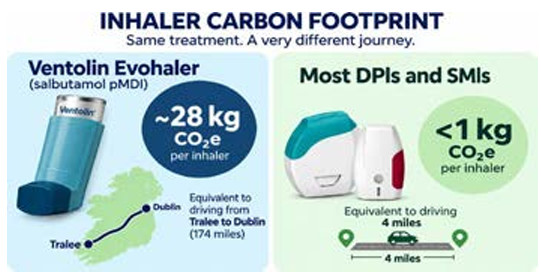
Ireland’s most frequently prescribed inhaler, the 200-dose Ventolin Evohaler (salbutamol) pMDI, has an estimated carbon footprint of approximately 28 kg CO₂e, compared with less than 1 kg CO₂e for most DPIs and SMIs. Carbon footprints also vary between pMDIs; Ventolin Evohaler uses more propellant per actuation than some other salbutamol pMDIs.
Image 3: Inhaler carbon footprint
Source: AI generated
A DPI may be suitable for a patient who can inhale quickly and deeply through the mouth for two to three seconds, but may not suit some frail older people, very young patients or those with insufficient inspiratory flow. Inhaler choice should be individualised and made with the patient and prescriber, with clinical suitability prioritised over environmental impact.
The environmental impact of inhalers extends beyond their use. When inhalers are discarded in household waste, residual propellant can be released into the atmosphere. It has been estimated that if every used inhaler in the UK were returned to a pharmacy for one year, the greenhouse gas emissions saved would be equivalent to approximately 88,600 VW Golf journeys around the world.
Patients should therefore be encouraged to return used, unused and expired inhalers to their pharmacy for safe disposal.
Pharmacists can influence disposal behaviour: one Irish survey found that 72% of respondents who had previously disposed of medicines had done so incorrectly, compared with 25% of those who had received disposal advice from a healthcare professional. With the launch of MediBack, pharmacies can now facilitate the disposal of returned medicines and have an opportunity to actively promote medicine returns to patients.
Many environmentally sustainable actions align with good medicines optimisation, clinical practice and patient-centred care. The following examples highlight practical opportunities that can be incorporated into routine community pharmacy practice.
Table 1: Environmentally sustainable actions for community pharmacy
| 1. Make Every Contact Count (MECC): Promote preventive care and healthy lifestyles | |
| Information | Make every contact count to support preventative care and healthy lifestyle measures; and Promote smoking cessation, physical activity, weight management, and signpost patients to relevant services and supports. |
| Environmental benefit | Preventing or improving the management of chronic disease management may reduce future healthcare and medicine use, providing a secondary environmental benefit. |
| Resources | HSE Making Every Contact Count (MECC) resources. |
| 2. Inhaler technique checks | |
| Information | Regularly check patients’ inhaler technique to optimise treatment and reduce exacerbations and over-reliance on reliever inhalers (often pMDIs); and Recheck technique following a change in inhaler. |
| Environmental benefit | Poor inhaler technique can result in poorly managed chronic respiratory conditions, which may require more healthcare visits and additional treatment; and Promoting good inhaler technique improves respiratory health while providing secondary environmental benefits by reducing inhaler use and reliance on reliever inhalers. |
| Resources | Asthma Society of Ireland; How to use your inhaler Asthma + Lung UK; and Summary of product characteristics and patient information leaflets for the relevant inhaler. |
| 3. Promote safe disposal of and accept return of unwanted medicines | |
| Information | Raise awareness of the environmental harm of inappropriate disposal of medicines; Promote MediBack for the return of unused medicines, particularly leftover liquid antibiotics and inhalers; and Advise patients on which medicines can be returned and how they should be presented (for example, tablets/capsules in paper, plastic or foil packaging, liquids in original bottles, injectables with needles removed/retracted). |
| Environmental benefit | Reduce the presence of pharmaceuticals in the environment which can cause harm to aquatic organisms and lead to antimicrobial resistance; and Incorrect disposal of inhalers can result in residual propellant being released into the atmosphere. |
| Resources | MediBack Checklist for Community Pharmacies; and Pharmacy Circular NCO-25-2026 Unused Medicines Return and Disposal through Community Pharmacy. |
| 4. Promote the use of solid oral drug formulations over liquid formulations | |
| Information | Children from four with normal swallow function can be thought to swallow solid oral dosage forms; and Solid oral dosage forms facilitate exact dispensing of quantity required. |
| Environmental benefit | Dispensing the exact quantity required can reduce pharmaceutical waste and the risk of inappropriate disposal; Solid oral dosage forms generally have a lower greenhouse gas footprint than liquid formulations; and Oral dosage forms contain less additives and generally have a longer shelf life. |
| Resources | Lim E, Parker E, Vasey N. ‘Why learning how to swallow pills is good for patients, parents, and the planet’, BMJ 2024. |
| 5. Review the ongoing need for PRN medicines before dispensing | |
| Information | Appropriate clinical checks and engagement with patient to ensure whether PRN medicines are required to prevent over ordering or over supplying and the subsequent generation of medicines waste. |
| Environmental benefit | Only dispensing required medicines prevents medicine waste and its associated environmental impact. |