




The generation of waste products from a range of sources, including those arising from our increasingly busy and consumptive lives, is on the rise. Their generation and disposal creates challenges for earth’s ecological systems and contributes to an overall deleterious effect on the health of our planet. While our personal lives represent a significant source of waste, our professional activities can also significantly contribute to the generation of waste and various pollutants. As healthcare professionals, we do important and life-enhancing work in supporting and promoting the health and well-being of those in our care. However, that work, vital as it is for so many people in receipt of healthcare services, is unfortunately not without its adverse environmental consequences. As a whole, the provision of healthcare is a significant contributor to the creation of a range of environmental pollutants. Medicines are the pharmacist’s stock in trade, playing a pivotal role in treating and preventing illness. However, their production, use, distribution and disposal gives rise to a range of environmental pollutants. The ever-increasing consumption of medicines due to changing population demographics and in part the ongoing development and introduction of more medicinal therapies, means that the ecological impacts of medicines is on a constant upward trajectory. Medicines-related pollutants can arise at multiple stages of their lifecycle, from manufacture to use, but the potentially polluting effects associated with their disposal, provided the impetus for undertaking this study.
Medication waste is defined as “any pharmaceutical product that remains unused or is not fully consumed during the entire pharmaceutical supply chain”. Globally, it is estimated that between 3 and 50 per cent of medications remain unused, while in Ireland, the Environmental Protection Agency in 2021 estimated that 29,000kg of medicines remained unused or expired annually. Appropriate disposal of these medicines, particularly in the domestic scenario, is critical to limiting their environmental contaminant effect. Inappropriate medicines disposal, such as discarding them down domestic sinks or sanitary systems or in domestic refuse, results in pharmaceutical residues potentially reaching waste systems, watercourses and terrestrial sites.
The aim of the study, conducted by four Year 5 MPharm students on placement in suburban community pharmacies over a four-week period (April/May 2025), was to systematically characterise and quantify medication waste over that period and to explore the underlying causes and potential economic impacts.
A bespoke audit tool was developed to collect data on:
Information was obtained on the reasons contributing to waste generation and the cost of the medicines wasted.
The cost of waste medication was estimated using stated wholesaler list price without factoring in any discounts. An estimated average value generated per pharmacy for a four-week period was calculated and extrapolated to provide a mean annual estimate of the potential value of medicines waste. This was then used to provide an annualised estimate of waste medicines across all pharmacies in Ireland.
A total of 299 waste medicine items were recorded across the four pharmacies, of which 90 per cent were prescription-only medicines (POM) while 10 per cent were over-the-counter (OTC) (Table 1).
Table 1: Total quantity of medicines waste stratified by source
| Source | Number of items | Total no. of units | % of total items |
| Patient returns | 216 | 6,451 | 72% |
| Pharmacy-generated | 83 | 2,035 | 28% |
| Total | 299 | 8,486 | 100% |
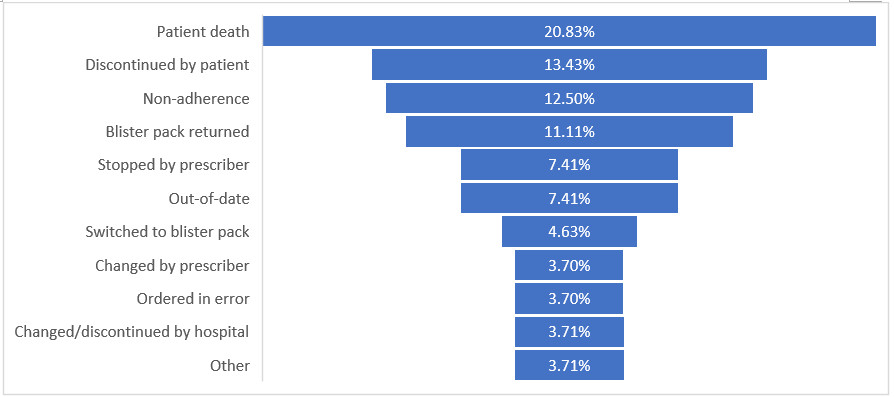
The primary reasons for patient returns were patient death (20.8 per cent), treatment discontinued by the patient (13.4 per cent), and general non-adherence resulting in medication accumulation (12.5 per cent) (Figure 1).
Figure 1: Reported reasons for medication returned by patients
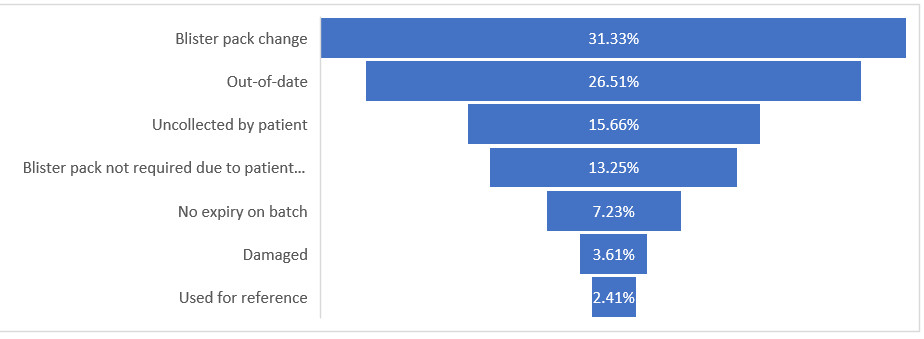
For pharmacy-generated waste, the most common reasons for disposal were blister pack amendments following treatment changes (31.3 per cent), expired medicines (26.5 per cent), and medicines left uncollected by patients (15.7 per cent) (Figure 2). Two pharmacy sites did not record any pharmacy-generated medication waste over the audit period as extensive stock-checking and destruction of any expired medicines was conducted in the recent period before the audit.
Figure 2: Reasons for pharmacy-generated waste medicines (percentage of total returns)
The total estimated economic value of wasted medicines generated by patient returns and pharmacy-generated was €6,049.87 across the four pharmacies during the study period (Table 2). Patient-returned items accounted for €4,928.39 (81.5 per cent) and pharmacy-generated waste for €1,121.48 (18.5 per cent). The average cost per wasted item was €20.23. Prescription items represented the majority of the economic burden, with an estimated cost of €5,903.66 (97.6 per cent), while OTC products accounted for €146.21 (2.4 per cent).
Table 2: Quantity and estimated value of medicines waste — patient returns and pharmacy-generated
| Source | Number of items | % of total items | Total units | Total value (€) | % of total value | |
| Patient returns | 216 | 72% | 6,451 | 4,928.39 | 81.5% | |
| Pharmacy-generated | 83 | 28% | 2,035 | 1,121.48 | 18.5% | |
| Total | 299 | 100% | 8,486 | 6,049.87 | 100% | |
Based on this audit in four community pharmacies, the mean value of medication waste generated per pharmacy of €1,512.47 over a four-week period extrapolates to an estimated value per pharmacy of €19,662.11 annually (52 weeks). From the PSI website consulted in November 2025, there were 1,908 community pharmacies registered in Ireland. Applying the estimated annual value generated in this audit to all community pharmacies, the annualised average value of medicines waste per pharmacy equates to a national economic burden in the region of €37.52 million.
This small-scale audit as conducted provides an initial observational insight of medicines waste generated in four community pharmacies in the spring of 2025.
As would be expected and in-line with previous aligned research, patient death was the most frequently reported reason for patient medicine returns to the pharmacy. Many of the medicines returned were anticipatory end-of-life medicines highlighting the importance of more prudent prescribing quantities for the terminally ill, given that dosing will often require frequent dose escalation and adjustment in the patient’s final days. It should also be noted that the ‘patient death’ category may capture medicines that accumulated for other reasons prior to death, such as poor adherence, therapy changes, or symptom changes.
Just over a quarter of medicines returned were due either to patients deciding to stop taking them or poor adherence to the treatment regimen. The reasons as to why patients decide to stop taking their prescribed medicines were outside the scope of this audit but likely include lack of perceived benefit or unwanted side-effects. Poor or non-adherence to medicines as prescribed is a globally recognised phenomenon, with adherence in those with chronic conditions estimated as low as 50 per cent. As these medicines are prescribed to treat various conditions and avoid adverse outcomes, addressing non-adherence is key not only to enhanced health outcomes, but also to reducing medicines waste. A compounding factor to non-adherence may also be the overprescribing of medicines. In tandem with many aspects of modern living, an increasingly consumerist approach to healthcare has emerged, where a medical response and more specifically medicines use is viewed as the solution to many of life’s challenges.
For pharmacy-generated waste, an interesting finding was that the most frequently cited cause was blister-pack amendments (31 per cent). The use of such monitored dosage systems (MDS) or medication compliance aids (MCAs) has attracted much attention recently relating to payment for their provision. While such systems are intended to support patient compliance, the supporting evidence of their effectiveness in this regard remains limited and their preparation in the pharmacy is both labour- and resource-intensive. The discarding of medicines from already prepared blister-packs due to treatment changes is a preventable source of medicines waste in pharmacies while used blister-packaging is a further source of waste, which may or may not be recyclable. Expired medicines were the second most common cause of medicines waste in pharmacies (27 per cent) followed by uncollected prescriptions (16 per cent). While uncollected medicines can generally be re-used, this may not be possible when expiry dates or batch numbers are unidentifiable, or the product has become too short-dated to re-enter pharmacy stock.
As expected, the key to avoiding medicines waste, whether pharmacy or patient generated, is prevention. This requires the engagement of multiple stakeholders including pharmacists, prescribers, patients and policymakers. Regarding the overprescribing of medicines, there are a range of ways that this can be avoided including prioritising prevention, choosing non-pharmacological treatment responses including social prescribing, reviewing the prescribing of ‘when required’ medicines, the provision of repeat prescriptions on an on-going basis and reducing antibiotic prescribing. Pharmacists in turn can play an active role in encouraging and promoting patient adherence. While a formal Medicines Use Review (MUR) initiative is not available in Ireland, a pharmacist’s legal and contractual obligations to review their patient’s medicine therapy and offer to counsel them on that therapy, provides an opportunity to ascertain what medicines they actually need and are taking.
The introduction of initiatives such as the Only Order What You Need campaign (NHS West Yorkshire Health and Care partnership) would support patients to engage with their pharmacists on only having those medicines which they need dispensed on any occasion. The success of the recent iSYMPATHY initiative in addressing polypharmacy and adherence demonstrated its potential for wider implementation nationally. The embedding of deprescribing and medicines optimisation into the prescribing and supply functions respectively would contribute to lessening medicines waste.
Not all medicines waste is avoidable, therefore it is important that there are appropriate and reliable systems in place to ensure their proper collection and disposal thereby limiting the potential for environmental contamination. This is generally predicated on there being in place take-back schemes for waste medicines that are nationally funded. The recent notification of the commencement of the MediBack Scheme for unused medicines return and disposal through community pharmacy is therefore welcome, as this will avoid the need for community pharmacies to incur the costs of medicines waste disposal and facilitate the safe disposal of returned medicines.
For pharmacy-generated medicines waste identified, there are various ways this can reduced. The significant contribution of MCAs through blister pack changes highlights the need to critically review MCA provision in practice. The dispensing of medicines in their original packs or equivalent should be the default choice in the absence of a specific need for an MCA in all settings. MCA use should only be offered primarily to support patient-safety and adherence, rather than patient preference or convenience. Expired medicines were responsible for 27 per cent of medicines waste in the audit. While some level of medicines expiration is unavoidable, the optimisation of stock control systems within pharmacies would help to minimise its contribution to medicines waste. Uncollected prescriptions accounted for 16 per cent of pharmacy-generated waste. This source of avoidable medicines waste could be mitigated by pharmacies having a system in place to determine whether patients intend collecting their prescriptions, rather than automatically dispensing all prescriptions as they are electronically transmitted via Healthmail.
The economic impact of medicines waste is significant. This study has estimated that the average value of waste medicines generated over a four-week period to be €1,512 per pharmacy, which when annualised and extrapolated to all pharmacies in Ireland, represents a potential cost in excess of €37.5 million per year. While it is acknowledged that this is based on a very limited audit of four pharmacies over a four-week period, it is likely an under-estimate when compared proportionately with the figure of £18 million estimated for annual medicines waste in Northern Ireland from its Department of Health in 2023. Further research to validate this estimated cost of medicines waste is warranted but whatever that value is, it represents avoidable wasted expenditure that could be redirected to enhanced patient care and outcomes elsewhere in the health service.
Notwithstanding the various limitations associated with this small-scale audit of medicines waste, it provides data on both the causes and potential economic cost of waste medicines in Ireland, neither of which have been previously researched in Ireland. Further research, drawing on a larger and more diverse sample of community pharmacies in Ireland is now required to more comprehensively explore the causes and economic cost of medicines waste. Analogous research is also required in the hospital sector to assess medicines waste there. The findings from such research would inform the development of effective and sustainable frameworks for medicines use, which would not only reduce environmental harm, but enhance both patient care and resource management.
For further detail on the audit and its findings, please see the full article in the Irish Journal of Medical Science, available at ink.springer.com by searching “Unused and expired medicines waste in Ireland – an audit of medicines returned to and generated in community pharmacies”.
References for this article available on request.
The authors wish to acknowledge the dedication and commitment of the four MPharm students Zlata Gerasimova, Neil Devlin, Arun Katheri and John Syjo who completed this audit while on their Year 5 placement in 2025.
They also wish to acknowledge the engagement, co-operation and support of the senior preceptors and staff of the four community pharmacies who participated in the audit and without whom, it would not have been possible.
The input of Stephen Walsh MPSI to the drafting of the published article in the Irish Journal of Medical Science is also acknowledged.