



The use of substances in Ireland is changing and is no longer dominated by the use of opioids such as heroin. Cocaine is responsible for 42 per cent (6,535 cases) of those presenting for treatment in 2025, particularly in the 20 to 44-year age group. This compared to 24 per cent for opioids (mainly heroin), mainly in the 45 years and older age group. Cannabis accounted for 15 per cent of new treatment cases, mainly in those under 19 years of age.
These statistics are collected from those accessing formal treatment services. However, there is recognition of more diversified drug use happening across all social groups and genders, which makes it harder to identify who may be at risk and to bring them into treatment. Researchers have surveyed drug use in student populations and those attending festivals and nighttime events to pick up on trends. The 2021 Drug Use in Higher Education in Ireland (DUHEI) survey reported that nearly 30 per cent of people used more than one drug at a time and 38 per cent of Irish respondents in the 2024 European Web Survey on Drugs reported they had used up to four drugs at some point in the past year. Almost 80 per cent were aware of safety precautions such as ‘going low’ (on the dose) and staying well hydrated.
However, awareness regarding the risks associated with co-consumption of multiple drugs and drug interactions was much lower. There are indications that drugs used in the 15–24-year-old group in Ireland are ketamine, inhalants and HCC (hexahydrocannabioid) vapes. These emerging trends are being carefully monitored by innovative means; for example, wastewater analysis conducted in Dublin in 2024 showed ketamine to be the third most consumed illicit substance; hospital toxicosurvelliance of substances consumed; and reporting of low threshold drug services of incidences for analysis.
Figure 1: Drug use by sex among Irish respondents (all ages groups) to the European Web Survey on Drugs 2024
Source: Mongan et al. via the HRB report ‘Strengthening Ireland’s response to new and emerging trends within the next policy life cycle’, available at drugsandalcohol.ie
Clinical use: Ketamine injection is approved for human use as an anaesthetic for sedation in surgery and as esketamine for surgery and pain. More recently, the esketamine form is available as a nasal spray (Spravate) for the treatment of severe depression under specialised care. It is also used in veterinary care.
Recreational/street use: It has been used a dance drug since the 1980’s, despite its sedative properties, due to its feelings of detachment and euphoria. It’s use in the past number of years has grown from use by a few to mainstream use. It was the fourth highest drug used in the 2021 DUHEI survey and 25 per cent of respondents in the 2024 European Web Survey on Drugs reported use. Stimulant drugs such as cocaine can be used with ketamine to overcome the sedation with reports of the use in festivals of so-called ‘CK’ or ‘Calvin Klein’. Use with depressant drugs like alcohol or benzodiazepines, (for example, alprazolam) or pregabalin can cause additional sedation. Ketamine can be adulterated before sale, and users should be aware of the lack of consistency in potency and content. Ketamine can be presented as ‘pink cocaine’, ‘tuci’ or ‘tusi’. which is a mix of different non-cocaine substances in the form of a pink powder. A recent alert from the HSE highlighted this combination (further information available on drugs.ie).
Image 1: Pink Powder — What’s in it?
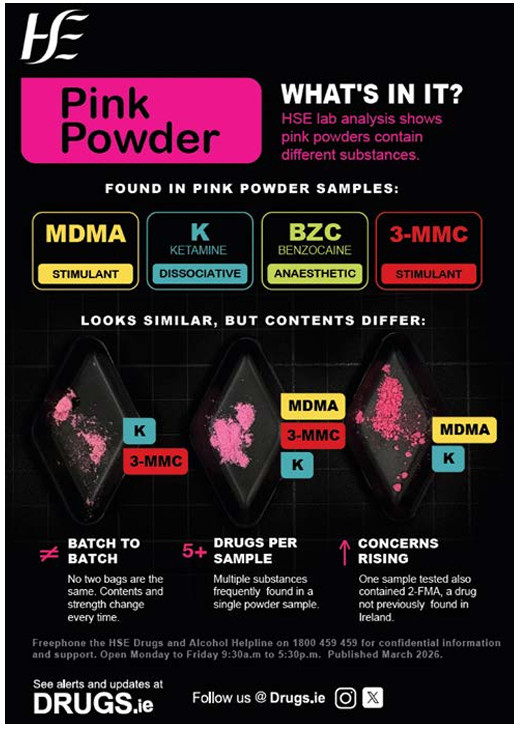
Source HSE alert. Drugs.ie
Effects of use: Effects of use include mind-body separation, impaired co-ordination, memory loss, and in high doses, respiratory depression. A dream like state can last six to 12 hours. Long-term use can result in depression, anxiety, psychological dependence and prolonged psychiatric symptoms. High dose use can result in what is described as a ‘K-hole’ where the brain is fully functioning, but the user’s body appears frozen/unresponsive. Other side effects are listed in Table 1. Ketamine can cause bladder toxicity, possibly due to metabolites excreted through the kidneys. Chronic use and consequent bladder irritation over many months can cause serious and irreversible tissue damage even after drug use has ceased. ‘Ketamine bladder syndrome’ is a serious condition which results in frequent urination and may result in surgery or a urostomy bag. Cessation of use is critical to stop the progression of this disease.
Table 1: Effects of Ketamine
| Short-term effects | |
| Allergy, skin reactions | |
| Cardiovascular and respiratory | Rapid heartbeat (commonly reported), hypertension, chest pain and respiratory arrest. |
| Gastrointestinal – nausea, vomiting | Nausea, vomiting. |
| Psychiatric | Confusion, dissociative state, delirium. |
| Muscular | Muscle stiffness and spasms, seizure like activity. |
| Long-term effects | |
| Gastrointestinal | ‘K-cramps’ due to long-term use. Vague abdominal pains, abnormal Liver Function Test results. |
| Psychological | Dependence and tolerance, leading to ongoing ketamine use. |
| Urological | Haemorrhagic cystitis, UTI-like symptoms including frequent urination, pain and haematuria in long-term users. |
| Cognition | Impairment of memory, daily functioning and overall wellbeing. |
| Neuropsychiatric disorder | Schizophrenia- like syndrome with long-term and frequent use. |
Source: Killeen N, Mc Namara S, Keenan E. ‘K culture’, ketamine’s prominent yet overlooked role on the Irish drug scene and implications for health. Ir J Med Sci. 2024 Jun;193(3):1557-1559. doi: 10.1007/s11845-023-03590-5. Epub 2023 Dec 16. PMID: 38104047.
Treatment of dependency: Techniques such as Brief Intervention, Motivational Interviewing and Cognitive Behavioural Therapy (CBT) with a particular focus on those with anxiety or depression due to past emotional trauma. Healthcare staff should use careful questioning in younger patients presenting with antibiotics for frequent Urinary Tract Infections (UTIs), which may mask ketamine associated cystitis. Most patients will not disclose ketamine use voluntarily. Harm reduction messages are highlighted in the alert ‘Ketamine Update’ (see Image 2).
Image 2: Ketamine Update
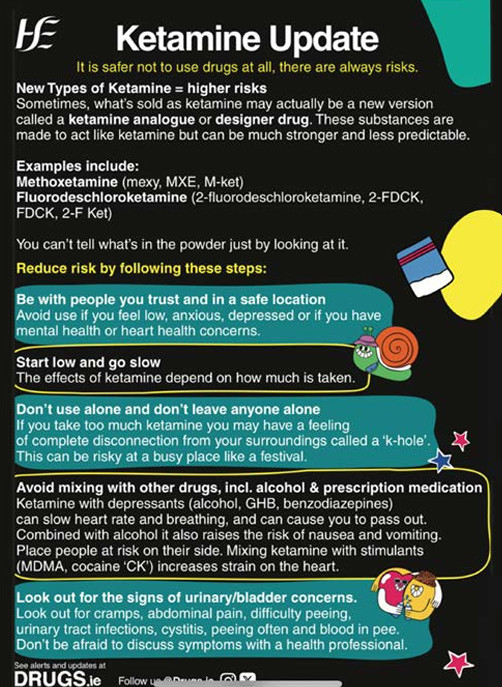
Source: drugs.ie
Table 2: Inhalants and their common chemical constituents
| Volatile solvents |
| Correction fluids (1,1,1-trichloroethane) |
| Dry-cleaning fluids (trichloroethylene, 1,1,1-trichloroethane) |
| Glues (n-hexane, toluene, xylene) |
| Nail polish remover (acetone, esters) |
| Paint thinners and removers (dichloromethane, toluene, xylene) |
| Petrol (benzene, n-hexane, toluene, xylene) |
| Aerosols (may contain chlorofluorocarbons and fluorocarbon propellants) |
| Deodorants and hairsprays |
| Fabric protector sprays |
| Spray paints (toluene, methyl isobutyl ketone) |
| Vegetable oil sprays |
| Gases |
| Bottled gas (propane) |
| Cigarette lighter fluid (butane) |
| Medical anaesthetics (ether, chloroform, nitrous oxide) |
| Whipped cream (nitrous oxide) |
| Nitrites |
| Amyl nitrite, butyl nitrate |
Inhalants include solvents, gases and aerosols found in common household products such as glue, paint thinners and hairspray or deodorant sprays. They release volatile gases, which can be sniffed or inhaled. They are highly lipophilic and cross the blood brain barrier to affect NMDA receptors in the brain causing a psychoactive effect. Reports of use are usually among adolescents and young people due to the accessibility and low cost. The European Web Survey on Drugs 2024 reported that 5.3 per cent of adults had used nitrous oxide. The ESPAD (European School Project on Alcohol and Drugs) 2024 found that 6.3 per cent of Irish schoolchildren had ever used inhalants, which is similar to the European average of 6.4 per cent. There has been an increase in young people seeking treatment in Ireland, with 66 seeking treatment in 2025, mainly along with other drugs.
Consumption: Users usually start by sniffing a container, then progress to ‘huffing’ from a cloth soaked in the substance and on to ‘bagging’ from a bag with the substance in it. Effects are felt within one to three minutes. Users may use up to 20 times over 10 to 15 minutes to give very high levels of exposure.
Effects: A short high/feeling of euphoria occurs. The short duration of the high can lead to repeated use. Short-term effects include hallucination, nausea and vomiting and loss of co-ordination. Long-term effects include damage to nerves, brain, heart, bladder gastrointestinal system and kidneys. Serious outcomes such as death can occur by suffocation due to lack of oxygen or due to accidents associated with risk taking or poor motor skills while intoxicated. These can occur with first time use. Nitrous oxide is associated with specific harms; physical harms including burns (from cold canisters) and nerve damage associated with vitamin B12 deficiency. This can present as numbness, tingling, movement disorder, bladder and bowel dysfunction. Nitrous oxide can also cause psychological symptoms such as delusions, hallucinations, paranoia, depression or acute psychosis.
Harm reduction:
Hexahydrocannabinol is a modified form of cannabis whereby the plant is altered to produce chemicals that do not occur naturally. It is categorised as a semi-synthetic cannabinoid and its effects on the body are similar to those of cannabis. HHC is produced from cannabidiol (CBD) extracted from tetrahydrocannabinol (THC), the major psychoactive part of cannabis. It is classified as a Schedule 1 controlled drug which means that the import, export, production, possession, sale, and supply of products containing HHC is illegal. It had been available for sale in so called ‘head shops’ but is no longer legal. The commercial availability of the product may have led the public to the illusion that they were ‘safe’ or ‘tested’, however, HHC has no medical or therapeutic value but has a high addiction potential. Despite a ban on the sale of HCC containing products in July 2025 there still appears to be products available for sale as vapes, which may contain HHC or a mixture of HHC and THC. NDTRS data reported that 97 people sought treatment for vaping HCC in 2025. Additionally, researchers in Galway University Hospital in 2024 found an association between HHC use and those presenting with psychosis.
Image 3: HHC image
Source: gov.ie/en/department-of-health/campaigns/hhc-hexahydrovannabinol.
Effects of use (dose can influence the effects):
Signs of dependency: These are classified by the ICD-11 and DSM-5 criteria which include low mood, irritability, insomnia and anxiety, which all compel the user to use again (and the situation worsens with time).
Treatment approaches: Psychological intervention with motivational interviewing, Cognitive Behavioural therapy (CBT), family therapy.
Harm reduction: Increased knowledge on the side effects of HCC and variable product potency.
Increase awareness of synthetic cannabinoids which are fully man-made chemicals. Synthetic cannabinoids, such as MDMB-4en-PINACA, function in a similar way to natural plant-based THC and bind to cannabinoid receptors in the body. They can be packaged in a similar way as HHC, for example, in vapes or e-liquids but can be much more potent and consequently more likely to cause more severe side-effects. There is no standardisation of manufacturing, meaning users may not know what they are buying.
A concerned parent feels that their 16-year-old son is using vapes cartridges that he purchases online. He has become irritable and withdrawn, and his schoolwork has declined. He vapes up to six times a day and admits that he “doesn’t feel great”, can’t sleep and is struggling at soccer training. What can be done?
Response: Recognise own limitations in this scenario in terms of experience and knowledge. Explain it may be a semi-synthetic drug similar to cannabis based on how he is feeling but a tactful discussion may be needed to get more information. Anxiety may be a driving factor for use, but ongoing use can worsen anxiety. Guide towards appropriate supports via HSE Drugs Helpline, 1800 459 459.
Protective factors: Supportive family, self-awareness of harms, still in school and interest in sport.
Possible outcomes: Discussion of short- term risks such as poor judgement and accidents while using, a decline in academic achievement. Visit GP to assess respiratory and physical health and refer to therapeutic counsellor if needed. Encourage engagement with age-appropriate activities, team sport, etc. Restrict access to online purchases. Provide help to support reduction in use, as may experience increased anxiety and craving.
Given that drug use is now shown to be common across all age groups and all areas of Ireland, it is important that community pharmacists are aware of this issue and familiarise themselves with harm reduction supports and resources available in their area. Further information can be found at drugs.ie/resources/factsheets. This site carries a range of factsheets on different drug types, including inhalants and cocaine and harm reduction posters for ketamine.
In a time with different drug trends emerging, it is important to remember the guiding principles of harm reduction, no matter what the drug is. Try to reduce the harm associated with drug use in a non-judgemental manner, even if drug use is ongoing.
Additional information resources from and Irish and International perspective are listed below: