



At the beginning of 2026, the outlook for global growth was generally positive, with the global economy expected to maintain the resilience that characterised 2025. Against a background of intense uncertainty relating to US trade policy and global geo-political disruption, the global economy proved very resilient in 2025. Growth surprised on the upside due to the front-loading of exports related to US tariff threats; fiscal expansion in many countries, particularly the US and China; looser monetary policy; relatively stable financial markets; and the AI related investment boom.
The general expectation was that this momentum would carry over into this year. Then on 28 February everything changed. The Middle East war has given rise to intense volatility and uncertainty. The real impact will ultimately depend on how long the war lasts, and unfortunately it is difficult to reach any firm conclusions in relation to when or how the war might end in a sustainable way.
So far, the impact of the war has been dominated by severe disruption in the Strait of Hormuz and the damage to oil and LNG infrastructure. Higher inflation is already materialising but provided oil prices stay around current levels a more severe inflation shock should be avoided. The first-round effects on inflation are being felt through energy prices, but the second-round effects could come through in areas such as packaging, fertiliser, transportation, and many other channels.
The Iran crisis has exacerbated an already difficult cost-of-living and cost-of-doing business situation in Ireland and elsewhere. This is leading to serious political disruption as evidenced by the recent energy protests in Ireland, and many governments around Europe have either delivered or are planning significant aid packages. This of course will have implications for public finances and will seriously exacerbate debt problems in countries such as Britain, Italy and France. At least in Ireland’s case, the €750 million package is coming from the budget surplus resulting from buoyant corporation tax receipts, but this spending will impact on budgetary policy going forward and the opportunity cost will become apparent as early as 6 October when Budget 2027 is scheduled to be delivered.
For central bankers the dilemma between the impact of the crisis on inflation and on economic growth is challenging. The crisis in the Gulf will drive inflation higher but will also damage economic growth. Central banks generally want to anchor inflation expectations and prevent an inflation psychology from becoming entrenched. Markets are quite clear on what will happen, with the ECB now priced to increase interest rates by 0.5 per cent over the coming months, with the first 0.25 per cent due to be delivered on 11 June. Personally, I believe that the threat to growth is greater than the threat to inflation, but that may not be the perspective of ECB officials.
Interpretation of the Irish national accounts is always challenging, given the nature of multi-national activities in the economy. In the first quarter of 2026, GDP declined by 12.1 per cent, and was 17.1 per cent lower than the first quarter of 2025. Export growth for much of 2025 was heavily distorted by front loading ahead of tariffs and this gave a major boost to activity for much of 2025. However, such export growth was not sustainable, and it has tailed off dramatically over the past six months. This has impacted significantly and negatively on the export contribution this year, meaning that GDP has fallen sharply, and this is likely to remain a feature for the next couple of quarters.
Output from the multi-national sector declined by 27.1 per cent during the first quarter, due to the sharp fall in exports, and output from the domestic sector expanded by 0.4 per cent. Modified domestic demand, a broad measure of underlying domestic activity that covers personal consumption on goods and services, government net expenditure, and investment spending, increased by 0.6 per cent during the quarter and was 4.3 per cent higher than a year earlier.
In overall terms, despite the statistical distortions, the real domestic economy performed solidly during the first quarter.
The labour market performance has eased somewhat so far in 2026. This is not surprising given the level of business and consumer uncertainty that the Iranian war has given rise to. An estimated 2,794,500 persons were employed in the first quarter of 2026. This is just 400 higher than the equivalent quarter in 2025, which is the slowest annual growth in some time. In the year to Q1, employment in the ICT sector declined by 20,200. It is still too soon to judge, but the impact of the AI spending boom may be starting to appear. It is not necessarily that AI is displacing jobs, but rather ICT companies are cutting costs to maintain AI investment levels.
The unemployment rate in May stood at 4.9 per cent of the labour force, up from 4.6 per cent a year ago.
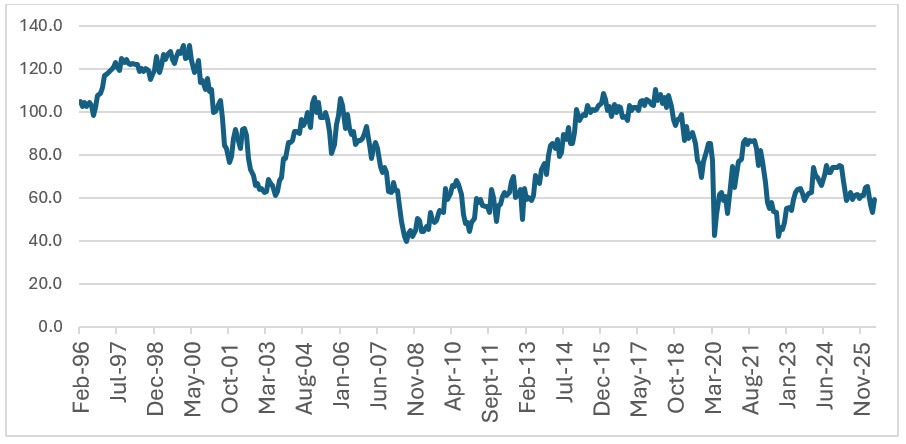
Consumer confidence took a heavy hit in March and April, declining by 18.3 per cent as consumers started to become deeply concerned about the impact of the Iran war. It then rebounded strongly in May, jumping by over 11 per cent. This improvement in sentiment was driven by easing energy costs, government support measures, and greater optimism about the ceasefire. The sentiment reading in May stood at 59.4, which is still well below the long-run average of 83.3. This fragility largely reflects cost-of-living pressures.
Of course, the Iranian war and the impact on the rest of the Gulf region is still ongoing and it is not clear how it can be resolved in a sustainable way. At the time of writing, the price of a barrel of Brent Crude Oil is standing at $97, but it had been up at $116 in early May. However, the price in June is still 59 per cent higher year to date.
Figure 1: Consumer Confidence
Source: ILCU
The retail environment is still quite challenging. In April, the volume of retail sales decreased by 0.2 per cent in the month and by 0.5 per cent in the 12 months from April 2025. When the motor trade is excluded, the volume of sales declined by 0.6 per cent in the month and was 0.4 per cent up on a year earlier.
In the first four months of the year, the volume of retail sales was 1.1 per cent higher than the first four months of 2025 and was 1 per cent higher when the motor trade is excluded.
Retail sales of pharmaceutical, medical and cosmetic articles were considerably stronger than the overall retail market, with the volume of sales up by 5.6 per cent.
The annual rate of consumer price inflation increased to 3.7 per cent in April, which is the highest rate since January 2024. The annual rate of inflation in the first four months of the year has averaged 3.05 per cent, which compares to an average rate of 2.2 per cent in 2025. The impact of the Iranian war is feeding through quite strongly, and this would be more pronounced but for the intervention of Government on cutting excise duties on motor fuels. The May rate is estimated at 3.6 per cent. In the year to April, the average price of Medicines, vaccines and other pharmaceutical preparations increased by 1.1 per cent, considerably lower than overall inflation in the economy.
This article is based on data available up to 8 June 2026.