



Home » Medication Optimisation Update

Helping patients optimise the use of their medication safely and effectively is a fundamental responsibility of community pharmacists.
This month’s Medication Optimisation Update highlights resources available to promote a medicines optimisation service in community pharmacies, discusses repeat prescriptions under the Common Conditions Services, and outlines what to discuss with patients when supplying Finasteride 1mg and 5mg tablets.
The Medicinal Products (Prescription and Control of Supply) (Amendment) Regulations 2026 (S.I. No. 138/2026) and the Misuse of Drugs (Amendment) (No 2) Regulations 2026 (S.I. No. 139/2026) introduce changes to how prescriptions must be endorsed from 30 June 2026.
This will only apply if the pharmacy is retaining the prescription electronically, otherwise the paper-based requirements above apply.
Please note that before community pharmacies can meet the legislative requirements outlined above for prescriptions transferred via Healthmail or the High-Tech Hub, pharmacy software providers (vendors) will have to make changes to pharmacy software.
The IPU will continue to inform members of updates on the implementation of these regulatory amendments through articles published in this magazine and other IPU communication channels.
S.I. No. 138/2026 and S.I. No. 139/2026 mentioned above are available from the electronic Irish Statute Book (eISB) irishstatutebook.ie.
Medicines optimisation is a person-centred approach to safe and effective medicine use. It helps to ensure people achieve the best outcomes from their treatments. Pharmacists play a key role in supporting patients in managing their therapies and enabling them to achieve better outcomes.
The IPU has developed a Medicines Optimisation page that offers a range of tools and resources to assist pharmacists in exercising their professional judgement when conducting patient assessments, discussing reasonable adjustment options, and maintaining records of decisions made when reviewing and addressing patients’ health needs.
For more information, visit the Medicines Optimisation page.
**Useful reference source
The National Institute for Health and Care Excellence (NICE) guideline NG23 Menopause: Identification and management, can be used as a tool by healthcare professionals when caring for women, trans men and non-binary people registered female at birth who experience menopause-associated symptoms. It should always be applied alongside professional judgment and in-line with the relevant code of conduct.
NICE guideline NG23 outlines the benefits and risk of hormone replacement therapy (HRT) prescribed within the licensed dosages. It was updated in April 2026 to include advice on when to seek help for vaginal bleeding while taking systemic HRT.
This guidance is available at nice.org.uk/guidance/ng23.
**External references are provided for information purposes only. IPU takes no responsibility whatsoever for the accuracy of the contents of, or information contained in, these references. Neither does IPU make any representation that the information contained at the link is appropriate or suitable for use in an Irish community pharmacy setting, or that it complies with any legal or regulatory requirements as they apply to community pharmacy practice in Ireland. Pharmacists should ensure that in all cases they use their own independent professional judgement, taking into account the individual circumstances that apply for their patient(s) and practice setting.
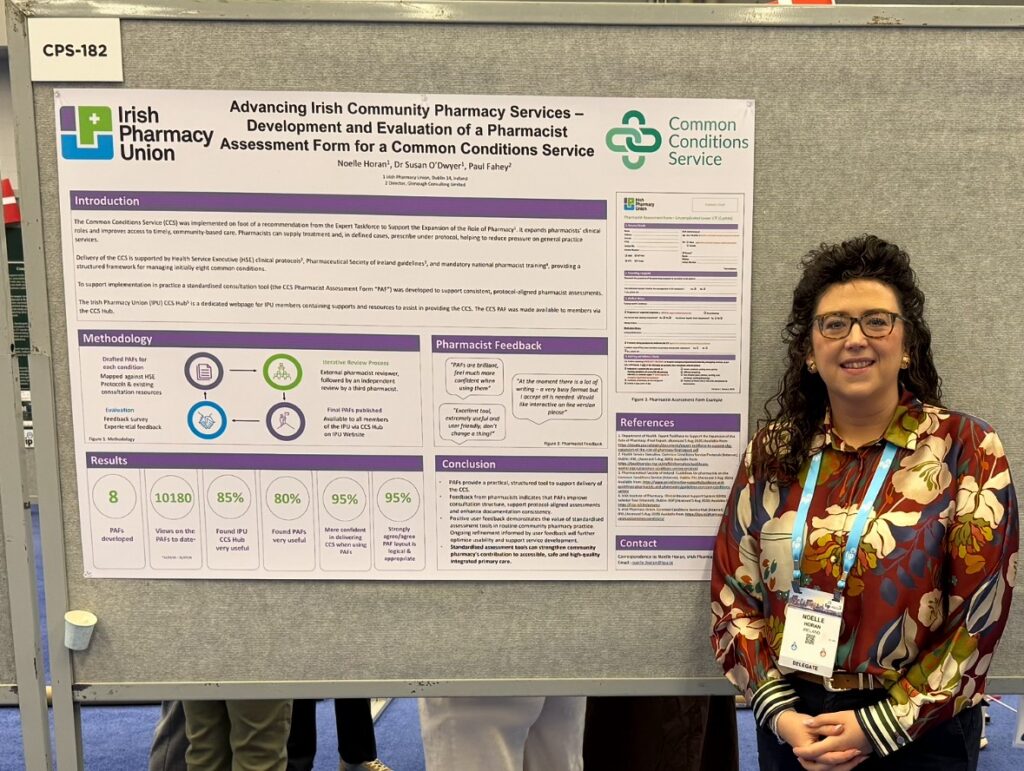
Pharmacists who have completed the Common Conditions Service (CCS) training may prescribe only those medicines listed in Schedule 13 of the Medicinal Products (Prescription and Control of Supply) Regulations, as amended. These medicines are prescribed to patients in accordance with CCS protocols. The CCS protocols outline the inclusion and exclusion criteria, as well as referral requirements, and provide details on medication (for example, dose and duration).
For example, there may be occasions where repeated use of an intranasal corticosteroid spray for the management of allergic rhinitis is observed. In such cases, a repeat prescription may be warranted.
CCS protocols are available from the HSE website at healthservice.hse.ie/staff > Information of healthcare workers > PCRS > Common Conditions Service Protocols.
Finasteride 5mg tablets (available as Proscar®, Fintrid® and generics) are indicated in men for the treatment and control of benign prostatic hyperplasia (BPH) and for the prevention of urologic events:
Finasteride causes regression of the enlarged prostate, improves urinary flow and improves the symptoms associated with BPH.
Finasteride 1mg tablets are indicated in men aged 18 – 41 years, for the early stages of androgenetic alopecia.
The following warnings and precautions from the SPC should be highlighted to male patients taking finasteride.
Effects on prostate-specific antigen (PSA) and prostate cancer detection
Digital rectal examination, as well as other evaluations for prostate cancer, should be performed on patients with BPH before initiating therapy and periodically thereafter.
Serum prostate-specific antigen (PSA) is also used for prostate cancer detection.
Finasteride causes a decrease in serum PSA concentrations by approximately 50 per cent in patients with BPH, even in the presence of prostate cancer. This must be considered when evaluating PSA data and does not rule out concomitant prostate cancer.
Analysis of PSA data from over 3,000 patients in the four-year, double-blind, placebo-controlled Proscar Long-term Efficacy and Safety Study (PLESS) confirmed that in typical patients treated with Proscar for six months or more, PSA values should be doubled for comparison with normal ranges in untreated men.
Breast cancer in men
Breast cancer has been reported in men taking finasteride during clinical trials and the post-marketing period. Physicians should instruct their patients to promptly report any changes in their breast tissue, such as lumps, pain, gynaecomastia or nipple discharge.
Mood alterations and depression
Mood alterations, including depressed mood, depression and, less frequently, suicidal ideation, have been reported in patients treated with finasteride. Patients should be monitored for psychiatric symptoms, and if these occur, the patient should be advised to seek medical advice.
Exposure to finasteride — risk to the male foetus
Finasteride is contraindicated in women who are, or may potentially be, pregnant. The ability of Type II 5 α-reductase inhibitors to inhibit the conversion of testosterone to dihydrotestosterone may cause abnormalities of the external genitalia of a male foetus when administered to a pregnant woman.
Women should not handle crushed or broken tablets of finasteride when they are or may potentially be pregnant.
Small amounts of finasteride have been recovered from the semen in subjects receiving finasteride 5 mg/day. When the patient’s sexual partner is or may potentially be pregnant, the patient is recommended to minimise exposure of his partner to semen.

Tara Kelly MPSI, Medicines Information Pharmacist, IPU; Lara Marín MPSI, Professional Services Pharmacist, IPU; and Sinéad McCool MPSI, Professional Services/IPU Professional Academy, IPU
Highlighted Articles