

Home » IPU National Pharmacy Conference 2026

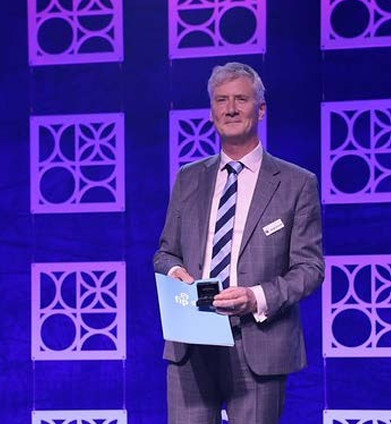
The IPU National Pharmacy Conference 2026 took place on 9 May in the Mount Wolseley Hotel in Carlow, featuring an exciting lineup of speakers, and a wide array of companies that support the industry. The event attracted strong representation from community pharmacists across the sector, with prominent speakers including the Minister for Health, Jennifer Carroll MacNeill TD. The event was hosted by Conall Ó Móráin, business broadcaster and MC.
Following time for the exhibition area, which featured a wide array of organisations providing information and supports to community pharmacy, the conference opened with outgoing IPU President Tom Murray handing the chain of office to incoming President, Caoimhe McAuley. Mr Murray said his two years as President came at a very busy period for the organisation, and he commended the “resilience and professionalism of our profession”.
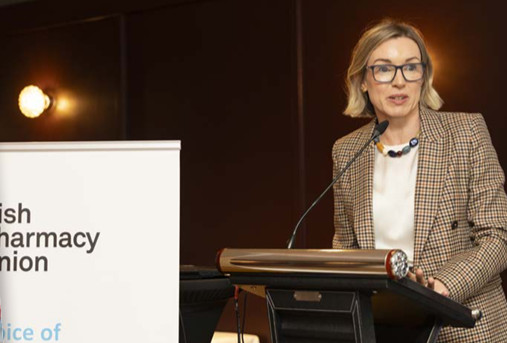
Ms McAuley then welcomed the Minister for Health, Jennifer Carroll MacNeill TD, to the stage.
Minister Carroll MacNeill touched on a number of points in her speech, which overall praised pharmacists for embracing and pushing forward with recent service changes, and emphasised the importance to the health service, of their dedication to their patients.
She thanked Mr Murray for his leadership at the IPU, and his “great determination and deep commitment to pharmacists and patients”. She also said that she looks forward to working with Ms McAuley going forward, saying it is a really important moment for pharmacy to “drive on and drive ahead”.
Minister Carroll MacNeill said the Community Pharmacy Agreement 2025 (CPA25), “is a hugely different way of pharmacists working” and cited reports she has heard from patients on the ground as “hugely exciting”. She said pharmacists are working for their patients with their expertise every day, and have stepped forward, taken on new responsibilities and new services and are showing patients what more pharmacy can do: “As a public representative you know how things are going by what people are telling you, and I’m getting positive feedback.”
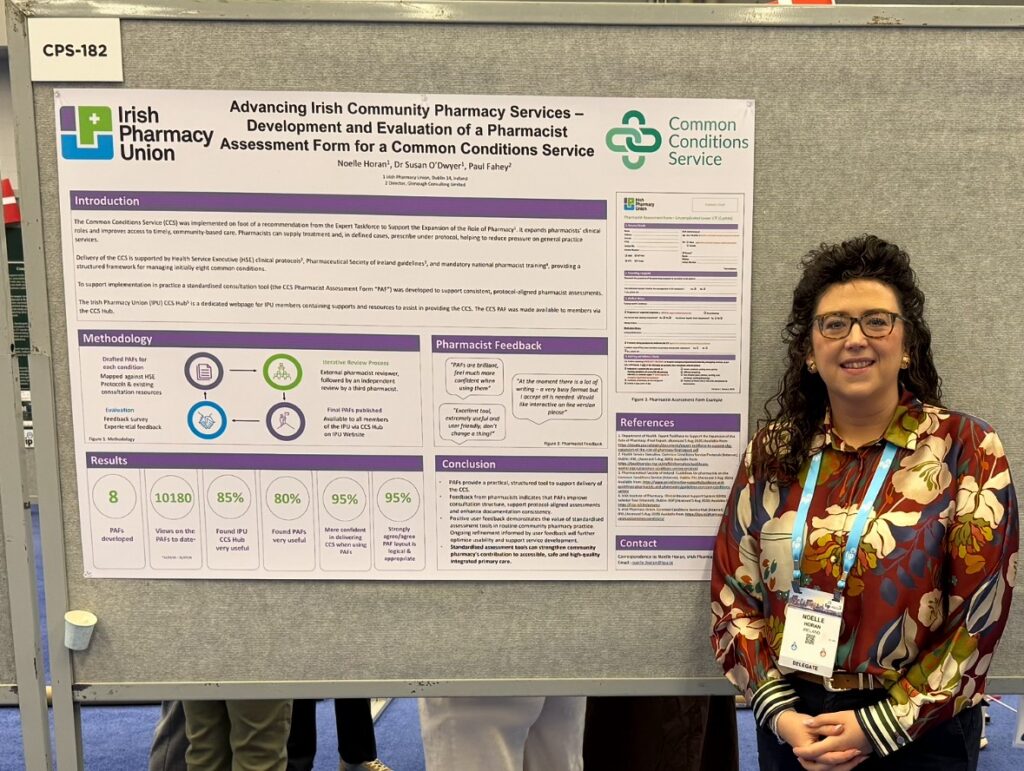
The Minister for Health then looked towards the expansion of the Common Conditions Service (CCS): “We’re hearing back on the progress already . . . it has taken vision, resilience and enormous professionalism and I’m excited to see what more we can get from it.”
She also thanked pharmacists for their enormous contribution to the vaccination programme and highlighted the importance of strong uptake in vaccination to allow other developments to progress, including the National Children’s Hospital, as the opening of it will be dependent on “how well the population is”.
Medicines safety was also highlighted as an important area in which pharmacists play a pivotal role, not least through the Unused Medicines Return and Disposal Service, which is part of CPA25. Minister Carroll MacNeill said by supporting the responsible disposal of medicines we are actively working on self-harm reduction and strengthening patient safety at vulnerable times.
The incomparable role of community pharmacy in its accessibility was a constant in the Minister for Health’s speech, as she emphasised that it’s not just about reaching people, it’s the ease of doing so. The role of pharmacy in BowelScreen under CPA25 was asserted as an enormous opportunity in making the service easier and more accessible and therefore improving rates of early detection.
The Minister also highlighted the important role of pharmacy in both the National Condom Distribution Service and PREP. She also said she was pleased to announce that the recruitment process for the Chief Pharmaceutical Officer will begin in June.
In closing, the Minister for Health emphasised the importance of the Irish Presidency of the Council of the European Union, which runs from July to the end of December. Saying this is the eighth time Ireland will have Presidency, Minister Carroll MacNeill said there is a real expectation for Ireland to make progress and cited the Biotech Act and amendments to the Medical Devices Regulation are key legislative priorities. She said it is Ireland’s opportunity to show our contribution to Europe and our commitment and expertise.
There were CPD sessions delivered on both business and professional subjects. The business CPD was entitled ‘Improving Pharmacy Processes’ and was delivered by Frank Olden, a pharmacist and member of the IPU Pharmacy Practice Working Group. The clinical CPD was on ‘Metabolic Syndrome in Mental Health’ and was delivered by Helen Danaher, Chief II Pharmacist in Mental Health Services at the HSE. The full presentations are available at ipu.ie.
Prof. Mary Horgan, Chief Medical Officer at the Department of Health spoke under the heading of ‘Reimagining Community Care: From Policy to Patient’ and opened her talk by outlining that she is a strong advocate for the role of community pharmacy and a “big fan” of a multi-disciplinary approach to healthcare. The crux of Departmental and Government policy is having a community care approach to healthcare, and she highlighted that 85 per cent of people live within five kilometres of a pharmacy. She spoke at length about the importance of immunisation, saying that if pharmacists were not doing vaccinations, then there would be a third less people vaccinated. There were less people needing acute care last during the flu season and “that’s down to immunisation”. She said we can see the impact of increased uptake in immunisation in Ireland, and likewise we are witnessing the impact of decreasing vaccination levels in other countries.
The CCS she said is here, and that is down to the work of the Community Pharmacy Expansion Implementation Oversight Group, which was a success because “everyone worked together to ensure it was delivered in a timely fashion”. She also said she is a strong advocate of further expansion of the CCS as it is “delivered by highly educated, highly trained healthcare professionals in the community”.
The impact of chronic disease was another area she touched on, saying it again highlights the need for multi-disciplinary teams working within communities to keep people close to home, including those with complex needs. An example of new initiatives working well which Prof. Horgan quoted was the GP Access to Community Diagnostics, which began accepting referrals in January 2021 and facilitates direct referral by GPs to a suite of diagnostic services (X-ray CT, MRI and DEXA Scans) through contracted private providers. There have been over one million community radiology scans since implementation, preventing referral to the acute hospital setting for these scans, and lessening pressure on hospital radiology Department waitlists.
She also touched on digitalisation, saying the Department “has a strong focus on agility, digital capacity and building a health service that is fit for the future”, and said the pandemic accelerated progress in a lot of areas, particularly in digital care. Prof. Horgan also highlighted the importance of pharmacists’ role in health promotion and the provision of accurate health advice, given community pharmacy is the most accessible healthcare provider.
Finally, she discussed the role of the Chief Pharmaceutical Officer, speaking of how closely she works with her contemporaries in the Department at her level, including the Chief Nursing Officer, as they are not “silo-ed” and work collaboratively: “That collaborative teamwork is what brings innovation to the table.”
‘Reaching and Sustaining Peak Performance Levels’ was the title of the address from Dr Kate Kirby, Head of Performance Psychology at the Sport Ireland Institute. Dr Kirby is a sports psychologist and emphasised that through her work across six different sports she has learned a lot about what good and bad practice looks like in terms of bringing a team together and working within a system instead of in a silo.
She provided a thoroughly engaging talk, which was grounded in her own practical reflections on decades working with elite level athletes. Above all, she emphasised that the precursor to getting people to change their behaviour is in building a relationship with them and ensuring they trust you and understand that you’re there to help them.
Dr Kirby said, most people who perform at a high level don’t need motivation, they need to be distracted from themselves and get out of their own way.
She also emphasised the importance of appreciating the role of others and asking them what they need from you, providing the example of nutritionist asking someone to bulk up and the psychological support they need for that.
She also highlighted that while the support roles around elite athletes monitor the athletes well, often the people in those support roles don’t monitor themselves sufficiently and get burntout. Dr Kirby said the biggest hack to avoiding this is in protecting your time; if you allow work to seep into all of your time, its a recipe for burnout. It is important to be protective of your time and say no when needed.
In the questions session after her address, Dr Kirby was asked about supporting staff and recognising when they’re having a bad day. She responded by going back to her initial point on building trust and nourishing relationships with staff members, so that even if the person who is suffering themselves is not in a position to raise it with you, another team member hopefully will be.
When asked how to spot when someone is having a very difficult time, she said avoidance and emotional detachment are usually strong indicators.
Finally, Dr Kirby was asked about ensuring staff have ownership of your goal, and she said it is important to differentiate measures of success; while someone working part-time may not view your profits as a metric of success, you could make it about customer experience for them, or have an array of metrics so one of them lands with each employee.
After lunch and further time in the exhibition hall, Larry Ryan, Director at Ipsos B&A, and Noel Winters, Partner at Fitzgerald Power provided a talk on ‘Review of the Pharmacy Sector — Public Perceptions and Business Reality’. An insightful discussion, Mr Ryan provided details of the recently completed Ipsos B&A survey on pharmacy usage and attitudes, on which a report will feature in the next issue of the IPU Review. Mr Winters explored community pharmacy sector performance in 2025. Both presentations are available at ipu.ie.
Similar to the morning’s scheduling, there were two CPD sessions held simultaneously in the afternoon, a business CPD session on ‘Managing Challenging Behaviour in Pharmacy’ delivered by Ronan Sheridan, pharmacist and IPU Professional Academy Assessor and a professional CPD session on ‘Advancing Patient Care: The Evolving Role of Pharmacists under the Community Pharmacy Agreement 2025’, delivered by Dr Susan O’Dwyer, Head of Professional Services at the IPU. Both presentations are available at ipu.ie.
The Great Debate closed conference proceedings, and it, as always, provided robust and insightful debate. Under the theme of ‘Reimagining Community Care — The Era of Opportunity’, Prof. Mary Horgan took to the stage alongside Dr. Caitriona Bradley, Founder and MD of Fios & Praxis Ltd; Sinead Lanigan, pharmacist and member of the IPU’s Employee Pharmacist Committee; and IPU President Caoimhe McAuley. Compered by MC Conall Ó Móráin, the panel took a number of questions from the floor.
Prof. Horgan was asked about the new Chief Pharmaceutical Officer (CPO) role and how she sees it shaping decision-making within the Department, including how responsibilities will be delineated between her office, the Chief Nursing Officer, and the incoming CPO to avoid overlap and ensure real impact. Prof Horgan replied that it is a key appointment, which will set out pharmacists’ roles in all policy and practical discussions, including in areas like antimicrobial resistance and point-of-care testing. She said, “we need the frontline inside knowledge to look at the same issues, but differently. I see the role as being the voice of pharmacy at a policy level”.
Mr Ó Móráin said that from his perspective as an outsider, it is very clear that there is a massive change in pharmacy, and asked the panel what further progression they see in the next three/four years?
Ms McAuley responded that she sees pharmacy as, “where you go to be assessed and treated . . . our patients want it more and more to be closest to their homes at the lowest level of complexity”. Highlighting all the work that has gone on in the background, Ms McAuley said community pharmacy can play this role while also holding onto “our central role as medicines experts”. Commenting on the wide-ranging benefits this will have on the health service, she specifically highlighted that it will massively benefit GPs and emergency departments and allow them to better deal with different levels of complexity.
When asked about charging, Ms McAuley was very clear that the current reimbursement set-up was not designed for the level of complexity community pharmacy is currently experiencing, and “we need to look at what model will allow us to best support our patients”.
Ms Lanigan highlighted that patients coming into pharmacies “don’t have data categories in their heads”, but they know pharmacies now have enhanced services and that further integration into the whole of the health service will increase the service provision that can be provided to patients.
Dr Bradley said that five years ago the profession looked very different to now, and “in the next three to five years I hope pharmacy will be recognised as a hub”. She expressed her hope that pharmacy will be part of an integrated system, and that having a CPO in place will allow for a more holistic, integrated approach; “The unique skillset of pharmacists, including de-prescribing, will be of benefit to the healthcare system.” She also said medicines optimisation is where pharmacists really excel and patients need to know their pharmacists are connected to the rest of the health system, preferably through the e-health agenda.
When asked when we will see pharmacists prescribing, Prof. Horgan said the appointment of a CPO will help with the vision of pharmacy: “I hope it will be sooner rather than later, but you can see the trajectory.” She also spoke about disinformation and misinformation when it comes to medical issues but said that the vast majority of the public trust their healthcare providers.
Ms McAuley followed this up by emphasising that community pharmacy is often able to connect with the hard to reach. She said there is huge public trust in pharmacy, which was emboldened during the pandemic when pharmacies were open and accessible — “we continued to be there for our communities”.
In terms of enablers or barriers to progress, Ms Lanigan highlighted workforce capacity, legislative and digital barriers, as well as AI and vendor support. Ms McAuley pointed out that certain areas can be enablers or barriers depending on how they are progressed, such as funding, saying we need the right model for the right future direction.
She also said it is about how we create resources and efficiencies that protect what community pharmacy is, and maybe look at doing things differently. She stressed that the relationship between the IPU and the Government and Department of Health has moved on fundamentally, and if we continue to keep working with them in the way that we have been, then things will change fundamentally.
It was a thought-provoking discussion and a fitting end to a conference packed with excellent and insightful speakers.
The AGM was held the day before the conference, a report is accessible here. The event closed with the Gala Dinner, which provided the opportunity for much needed reflection on the day’s proceedings.
Presentation slides from the conference are available at events.ipu.ie.
Siobhán Kane
Editorial Manager, IPU
Highlighted Articles