



To mark IOAD 2026, the HSE National Social Inclusion Office (NSIO) will host a free 90-minute live webinar on Monday 31 August, from 1.00pm to 2.30pm.
Pharmacists are encouraged to register and attend to help end overdose, remember those who have died without stigma and acknowledge the grief experienced by family and friends.
International Overdose Awareness Day (IOAD), marked annually on 31 August, brings communities together to remember lives lost to overdose, support those grieving, and take action to prevent future deaths.
In 2026, IOAD marks its 25th anniversary under the theme ‘25 Years. Still Needed.’ — a reminder that overdose remains a public health issue and that prevention efforts must continue.
Overdose continues to affect every community. Yet, it can be prevented.
Community pharmacists are uniquely placed to play a frontline role in overdose prevention, through patient engagement, education, and access to naloxone.
To mark IOAD 2026, the HSE National Social Inclusion Office (NSIO) will host a free 90-minute live webinar on Monday 31 August (1.00–2.30pm).
As part of the world’s annual campaign to raise awareness of drug-related overdose, pharmacists are encouraged to register and attend to help end overdose, remember those who have died without stigma and acknowledge the grief experienced by family and friends. See the QR code in the box on page XXX for link to the webinar.
Jenny Smyth, HSE Naloxone Project Lead, who co-ordinates the IOAD events for the HSE said, “This year the webinar will be focusing on targeted intervention partnerships between statutory services, peers and addiction/homeless support services. We will hear from HSE colleagues, the National Ambulance Service, UISCE, the Irish Prison Service, peers and community support services. They will share insights on the naloxone programme, how to recognise an overdose, actions we can take, the value of peer-to-peer engagement and demonstrate the importance of meeting people where they are.”
The webinar will be hosted by the National Naloxone Oversight Quality Assurance Group’s Chair, Dr Denis O’Driscoll, Superintendent Pharmacist, McCabe’s Pharmacy Ireland, part of the Phoenix Group and Vice President of the PSI Council.
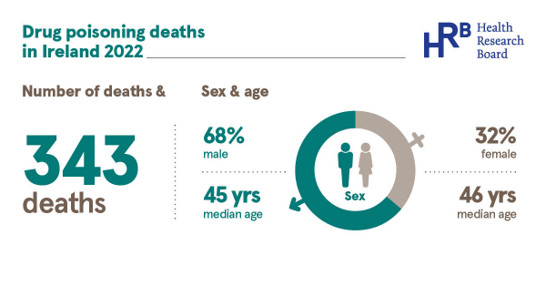
Dr Denis O’Driscoll said; “The Health Research Board recorded 343 drug poisoning deaths in 2022, with opioids implicated in 65 per cent of cases. International Overdose Awareness Day remains vital in Ireland — to remember those we have lost, raise awareness, reduce stigma, and promote actions to reduce overdose deaths. Community pharmacists, as highly accessible healthcare professionals, play a crucial role in harm reduction and overdose prevention.”
Source: hrb.ie
Mr O’Driscoll continued; “In honour of 25 years for IOAD 2026 the HSE NSIO will be promoting overdose awareness/naloxone education sessions across Ireland focusing on supporting Circle graduates peer-to-peer to facilitate education sessions and prevent overdoses. The Circle Programme (Peer to Peer Overdose Prevention) is a peer skills and education programme on overdose risks, prevention and management. This peer programme supports people who use drugs to understand overdose risks, take steps to prevent overdose and manage effectively if they are around someone who is overdosing. The graduates then volunteer in a peer-to-peer overdose prevention role in their communities.” The Circle Programme was a nationwide rollout of the TOPPLE Programme, developed by Novas in 2014.
Community pharmacists are often the first point of contact for patients at risk and play a critical role in overdose prevention.
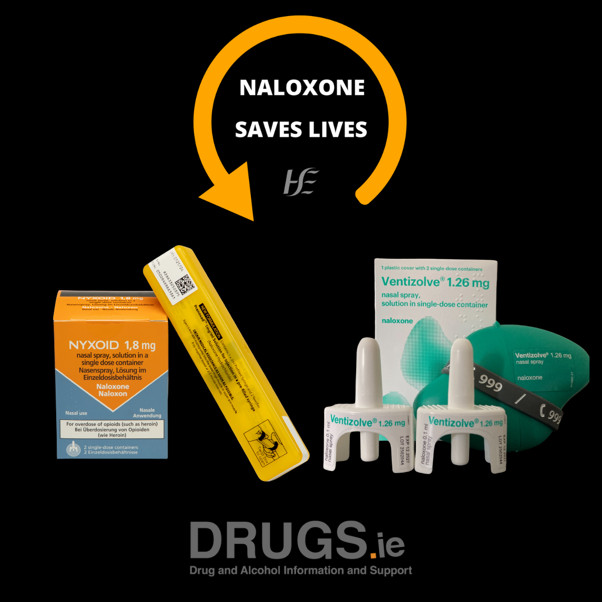
Naloxone is a prescription-only medication used to temporarily reverse the effects of an opioid overdose. It can be lifesaving when used promptly in an opioid overdose while waiting for an ambulance to arrive.
There are currently two types of naloxone available in Ireland:
Pharmacists may supply naloxone to a Listed Organisation under current legislation. Before supplying:
PSI guidance on this process is available at psi.ie > Practice Supports > Practice Updates and Learnings > Supply of Emergency Medicines (updated January 2018).
The PSI website details the training requirements for pharmacists to supply and administer naloxone in emergency situations. The relevant page on the PSI website can be accessed at psi.ie > Education and Training > Emergency Medicines Training. You can enrol on the HSE Opioid Overdose Awareness and Naloxone Administration Training eLearning (Module 1) course by logging into HSeLanD and using the ‘search a module’ tool with the key word ‘naloxone’.
This course was developed by the HSE National Social Inclusion Office to provide learners with the skills to recognise, intervene and respond to an opioid overdose, including the administration of naloxone. Module 1 has been completed over 5,100 times since its launch at the end of January 2024.
Community pharmacies are among the most accessible and trusted healthcare providers in Ireland, and it is essential that they are prepared to administer emergency medicines safely and effectively.
The Community Pharmacy Agreement 2025 introduced the Emergency Medicine Administration Preparedness Allowance, recognising that community pharmacists are authorised to administer emergency medicines and financially supporting them to be appropriately trained and ready to respond, often on an ad hoc basis.
An annual allowance of €525 has been available to community pharmacy contractors since January 2026 to support this preparedness.
Naloxone is included in the Emergency Medicine Administration Preparedness Allowance, which is available as part of community pharmacy contracts.
This support helps ensure that pharmacies are equipped to respond to emergencies and play an active role in saving lives.
Prof. Eamon Keenan, HSE National Lead, Addiction Services said; “Naloxone remains a key intervention in reducing opioid overdose deaths. Earlier this year we welcomed the introduction of the Emergency Medicine Administration Preparedness Allowance, which provides financial support to pharmacies to procure and maintain naloxone on site. Based on international literature on survival outcomes, it is estimated that at least 16 lives were saved through the administration of naloxone on 417 occasions in overdose situations last year.”
Prof. Keenan added; “We thank each pharmacist who completes the HSeLanD Opioid Overdose Awareness and Naloxone Administration eLearning (Module 1) and ensures naloxone is available in their pharmacy — a measure that has the potential to save lives.”
Background: In December 2016, the HSE established a multi-agency working group to examine the need for and progression of, the establishment of a Medically Supervised Injecting Facility (MSIF). Concurrently, a legislative process to enable the establishment of an MSIF was progressed through the Department of Health.
Funding was secured by the HSE in 2017 to progress with the establishment of the MSIF and an invitation to tender was issued, determined by the findings of the literature review, surveys, mapping exercise conducted through the working group, and the experiences of similar facilities in other jurisdictions. Merchants Quay Ireland (MQI) were successful in their bid in early 2018. The HSE supported MQI to secure planning permission and additional capital funding to establish the MSIF in their existing premises. There were long delays in securing planning permission, but the MSIF opened on 22 December 2024.
Activity: In the first year of service 1,471 individuals used the MSIF during 15,175 visits, of which 77.4 per cent were men, and 63.4 per cent were between the ages of 25 and 44. There were 244 non-fatal overdose incidents within the MSIF in 2025. 43.4 per cent of those incidents were successfully managed with the administration of oxygen and naloxone, with 56.1 per cent successfully managed with the administration of oxygen alone.
Governance: MQI have a service level agreement with the HSE which sets out the terms of funding, reporting obligations, expected outcomes, key performance indicators and governance structure for the MSIF. The Clinical Governance Committee for the MSIF, which has an independent chairperson, has oversight of the clinical operation of the MSIF. The Stakeholder Forum, chaired by MQI, is a monthly forum for ongoing engagement with local community, school, business, non-statutory and statutory representatives, to ensure the efficient operation of the facility and to protect the amenity and safety of the local neighbourhood.
Evaluation: Queens University Belfast and their partners, Trinity College Dublin, were engaged by the HSE to conduct the independent evaluation of the operation and impact of the MSIF service and a child impact assessment of the MSIF, over the first 18 months service. The evaluation is overseen by the Research Advisory Group, chaired by the HSE National Clinical Lead for Addiction Services. The interim report of the evaluation was completed in 2025. The final report, along with the child impact assessment, is due to be completed in Q4 2026.
The pilot phase of the MSIF is due to end in June 2026. Permanent planning permission for the MSIF in MQI was granted by An Coimisiún Pleanála in May 2026.
Actions for pharmacists