



Home » Caoimhe McAuley elected IPU President
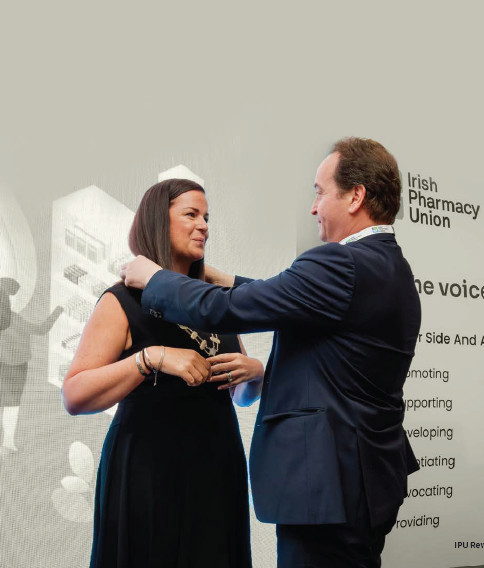
Ms McAuley has been actively involved with the IPU for a number of years, serving as Vice-President for the past two years, representing the full breadth of community pharmacy and working to support all members regardless of their employment setting. She has been a consistent voice for unity within the sector, believing that a strong IPU is a united one and has contributed to national discussions on the evolving role of pharmacy within primary care and the wider health system.
She brings more than 20 years’ experience in community pharmacy, with a career spanning frontline practice, operational leadership and national service delivery. In her role as Director of Pharmacy and Superintendent Pharmacist at Boots Ireland, she has overseen the development and expansion of a wide range of community pharmacy services, including vaccination programmes, women’s health initiatives and public health services delivered at scale.
Mc McAuley was elected IPU President at the recent IPU National Pharmacy Conference, and over the following pages we print in full her Presidential Address to the conference on 9 May.
Minister, colleagues, friends, good morning everyone, and thank you all for being here today.
I want to especially acknowledge the presence of you, Minister, and our colleagues from the Department of Health. You are very welcome. Your attendance here this morning is greatly appreciated. It reflects not only the importance of community pharmacy within our health service, but also the strength of the relationship and engagement that has developed between our profession and Government in recent years.
That relationship has helped begin a real journey of transformation for community pharmacy — one built on trust, collaboration and a shared ambition to deliver better care for patients. It is a journey that has already achieved meaningful progress, and as I begin my term as President, it is one I intend to continue with energy, purpose and momentum.
Becoming the IPU President is an honour I don’t take lightly. To be elected President is to be trusted with something that matters — the voice of a profession that touches more lives, more consistently, than almost any other part of our health system.
I also want to take a moment to acknowledge the presidents who came before me. Each of them shaped this Union — through the negotiations that didn’t make headlines, the relationships built over years, the groundwork that made today’s progress possible. And to my immediate predecessor Tom, thank you for your support and guidance, as I served as Vice-President with you over the past two years.
We stand at an inflection point for our profession, made possible by the strong foundations they have built.
When I look at where we are today compared to where we were five years ago, the change is real.
The Programme for Government contains meaningful commitments to community pharmacy – commitments we fought for, and commitments that reflect a growing understanding at government level of what pharmacy can and should do.
The Community Pharmacy Agreement gives us a foundation. The question now is how we build on it.
There has been good progress. Real progress. And we need to continue at pace.
We’ve secured a core fee increase for the first time in 17 years. Pharmacists are now recognised as prescribers, as medicines experts, and that is a genuine shift in how this profession is seen and valued by the patients we serve, the wider public and by our allied healthcare professionals.
And the digital transformation underway across our sector is real — reducing administrative burden and freeing us to focus on what we’re actually here to do. Serve our patients.
Before I talk about where we’re going, I want to ground us in something important.
Every year, the IPU commissions Ipsos B&A to find out — and you’ll hear more from B&A later when Larry presents an update. Two thousand adults. Nationally representative. Face to face and online. And I want to share some of what they told us this year – because it matters for the argument we’re making.
Three out of four adults rate pharmacists very highly or highly relative to all other healthcare professionals.
Three in four give positive assessments of the clinical services available in their pharmacy.
And when it comes to accessibility, availability, and value for money – particularly compared to the cost of a GP visit – pharmacy continues to lead.
More than four out of five people believe that Common Conditions treatments should be free to medical card holders. That is not a fringe view. Minister, that is the public telling us, clearly, that they see pharmacy as part of the health system – not a private add-on to it.
There is real enthusiasm for pharmacy doing more. Strong interest in medication reviews, health screening, blood pressure monitoring. Continued and growing engagement with women’s health; menopause, contraception, HPV vaccination. The public are not waiting to be convinced. They are already there.
The move to online is real, and it is changing the shape of part of our business. But here is what I think that means for us, if we respond to it correctly.
It means that the pharmacy at the heart of the community becomes more important, not less. The dispensary, the OTC conversation, the trusted relationship with the pharmacist who knows your name and your history — that is what online cannot replicate. This is our ground, our expertise, and we should be building on it.
Community pharmacy as a healthcare hub — a place where people come not just to collect a prescription but to be seen, assessed, monitored, supported. Where we are, in the fullest sense, the front door of the health system for the communities we serve.
The public trust is real. The appetite for more is real. I know the IPU team are working across the Department of Health and with the HSE to deliver our shared ambition. Our job, together, is to close the gap between what people believe pharmacy can do and what the system currently allows us to deliver.
That’s not a slogan — it’s a reality. The quality of care a patient receives depends directly on you, the professionals behind the counter and everywhere else you meet your patients — your knowledge, your availability, your capacity to engage.
If we get the people question wrong, nothing else holds.
I want to be honest about something that doesn’t get said clearly enough.
Community pharmacy in Ireland is overwhelmingly made up of small and medium-sized operators. Pharmacists who got into this profession because they care about their patients and their communities — it’s not a job, it’s a vocation. The IPU has your back. That is not in question.
But we need to shine a light on the environment they are operating in. Because it is becoming difficult to sustain with an ever-increasing cost base, and these are being acutely felt by pharmacies the length and breadth of the country, with increases in minimum wage, auto-enrolment of pensions and cost rises across energy, insurance and IT. We need to ensure the quality service that we currently deliver remains so into the future.
Everyone in this room understands the funding reality. 82 per cent of dispensary revenue is publicly funded. We are price takers both on fees and on medicines prices. But the costs to run a community pharmacy today are only moving in one direction, as it is for every small and medium sized business in the state, community pharmacies are not immune.
The Q1 Pharmacy Pulse survey tells us that 94 per cent of pharmacies experienced operational cost increases over the past twelve months. 94 per cent. That is not a trend. That is a sector under sustained pressure.
And unlike most businesses, we have no ability to pass those costs on. That leads to a squeeze — and to compromises that no pharmacist should have to make to remain viable.
I don’t want to them just to be viable, I want them to thrive, I want to be able to deliver the future services we all want to see, and to do that with the quality that the patients deserve. Minister, the June review is the moment to move on this. Not a conversation – progress towards a clear framework that honestly reflects cost pressures and makes reasonable adjustments.
And let’s be clear about what this sector has not only taken on but embraced.
New services. Expanded clinical roles. New agreements. We have met every ask that has come our way, and we have done it with professionalism.
What we need in return is a funding model that keeps pace in the changing environment in which we operate.
We welcome the uplift in fees as part of last year’s Community Pharmacy Agreement. But the June review remains vital, particularly as costs continue to soar. The IPU will be making that case with full force — and I want every member in this room to know that we go into that process with your reality front of mind.
Because here is what concerns me most. And what should concern all of us.
This is not just a financial question. It is a health equity question.
The pharmacies most at risk are in the communities that can least afford to lose them. Rural towns. Disadvantaged urban areas. Places where the pharmacy is the most accessible healthcare touchpoint for miles around.
A quality pharmacy service requires a sustainable pharmacy sector. Those two things are not in tension — they are the same argument. And we will be making it, clearly and without apology, to you Minister, to government, to the Department, and to anyone else who needs to hear it.
The IPU Vision 2030 is not abstract to me. The outstanding actions from the White Paper are not a list to be managed — they are a blueprint, and I want us to use it.
The direction of travel is clear. Pharmacy as a first point of contact. Pharmacists working at the top of their licence. Services that reflect what the public already believe we can do. A profession that is not just part of the health system, but central to it.
Getting there requires two things working in parallel.
First, the policy and funding environment needs to reflect the ambition — and that’s where this Union’s advocacy has to stay sharp and relentless.
Second, our own house needs to be in order. Employee engagement is not a soft metric. A profession that doesn’t invest in the experience of the people working within it will not attract or keep the talent it needs.
If we want to draw the next generation into community pharmacy — and we do — they need to see a sector with a future. A sector that values them. A sector that is worth choosing.
We have new Schools of Pharmacy opening a fresh pipeline of talent and I’m delighted to see students attending and engaging with our event today. Our job is to make sure the sector they’re entering is one that’s ready for them.
Being your president is a distinct honour. And I want to be straightforward about what I intend to do with it.
I will engage tirelessly on your behalf. I will champion the vital role we play in our communities and the impact we have on society. I will have good faith conversations to advance this profession – because the strength of what I bring to any of those conversations is representing all of you.
The distinctions that have sometimes divided us — independent versus chain, community versus hospital, urban versus rural — are less important than what we share.
We share a patient. We share a vocation. We share a future.
That is not a political position. It is the only position that makes sense if we want to keep moving forward.
When I think about our ongoing engagement with the Department and with you, Minister, the word that comes to mind is — opportunity.
We welcome the progress. We value the partnership. The relationships are good, the policy framework is moving in the right direction, and the public are on our side. This is not a moment to be timid. This is a moment to push. So let me be clear about what this Union will be pressing for.
The expansion in the role of the pharmacist is most welcome. But fair, full reimbursement is not a negotiating position — it is a baseline. The clinical value being delivered in pharmacies every single day deserves to be properly recognised and properly funded.
On sustainability — the current funding model was not built for what community pharmacy is now being asked to do. Demand is up. Costs are up. The workforce is under pressure. We are asking for a funding structure that reflects reality.
On workforce — if government wants pharmacy to carry more of the load in primary care, and the evidence says they do, then they need to help us plan for the people who will deliver it. We want a real workforce strategy – with the Department – not a conversation. A plan.
The IPU White Paper made commitments. The Programme for Government made commitments. I am not in the business of letting those gather dust. We will be holding the line on delivery and naming the actions that are outstanding until they are done.
And the Chief Pharmaceutical Officer — the role will soon be advertised, and it needs to have genuine influence. Not a seat in the room for appearances. Real leadership, properly resourced, with the authority to shape decisions. We will be watching that closely – and cheering on its success.
The changes coming to Fitness to Practise are welcome. A modern, proportionate process protects patients and supports pharmacists — it reflects a profession that takes its responsibilities seriously and is willing to hold itself to account.
We have engaged constructively on those reforms, and we will continue to do so. But legislation cannot stop there. The case for pharmacist autonomous prescribing has been made.
The clinical competence is there. The public trust is there. The demand is there.
What is needed now is the legislative change to make it a reality. Minister, we are asking you to prioritise that — not as a future ambition, but as an active commitment with a timeline.
Now, I’ll be the first to say, progress doesn’t happen in speeches or behind lecterns. As you know, it happens in the hours between them.
It happens in the committees, where many of you are helping to drive our profession forward. It happens with the team at Butterfield House who show up every day with a level of commitment to this profession that I find genuinely humbling.
The long hours, the detailed work, the quiet determination to get things right — that is what moves this agenda forward. They have my deepest thanks.
It happens in the conversations with colleagues in the Department of Health who share our ambition — who understand that a strong community pharmacy network is a resource to be treasured and invested in. That shared understanding is hard won and worth protecting.
And it happens in this room. With the pharmacists and pharmacy teams across this country who keep showing up for their patients, in communities where they are often the most constant presence in people’s healthcare journeys.
Our strategy is bold. The moment calls for it.
The public are with us – more than the data even captures, because trust like that takes years to build and is felt in every interaction, every day, in pharmacies the length and breadth of this country.
What’s needed now is the confidence to use the position we’re in. To make the case clearly that community pharmacy is not a convenience — it’s infrastructure.
That the pharmacist is not a last resort — they are, for many people, the most consistent, most accessible healthcare professional in their lives.
This profession has earned its seat at the table. I intend to make sure we use it. Thank you.

Highlighted Articles