



The Autumn Winter Vaccination Programme began in early October 2025. Similar to previous seasons, co-administration of the seasonal influenza vaccine and COVID-19 vaccine continued to be encouraged for eligible individuals. 1,140 pharmacies offered both influenza and COVID-19 vaccination services. Vaccination administrations commenced in earnest with community pharmacy administering over 80,000 vaccines per week at times during October. The COVID-19 autumn campaign continued until the end of February 2026 while the seasonal influenza campaign (IIV) ended on 30 April 2026. The administration of nasal flu vaccinations to children aged 2-17 years concluded when the LAIV products expired on 17 February 2026. Any children in risk groups requesting an influenza vaccine after this time could be given an injectable vaccine where appropriate.
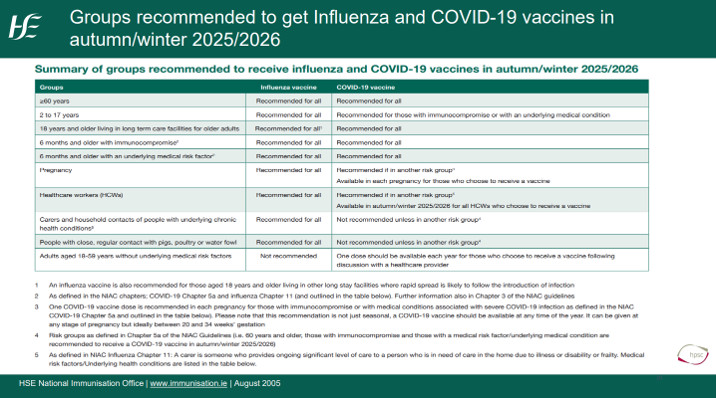
The recommended groups for the 2025/2026 season who were eligible to receive the free influenza and COVID-19 vaccines through the HSE national programmes are outlined in Image 1.
Image 1: Groups recommended to get Influenza and COVID-19 Vaccines in Autumn Winter 2025 2026
1456 community pharmacies offered a seasonal influenza vaccination service during the Autumn Winter Programme. This represented a continuing trend of additional pharmacies providing this service each year since it commenced in 2011.
Annual revaccination for influenza is recommended as immunity declines after vaccination and circulating strains of influenza virus change from year to year. Vaccines recommended by the World Health Organization (WHO) are prepared each year, using virus strains similar to those considered most likely to circulate in the forthcoming season. The WHO concluded ahead of the 2024 vaccination season that B/Yamagata lineages were no longer circulating (last detected March 2020) and were unlikely to cause future epidemics. Therefore, inclusion of a B/Yamagata antigen component of influenza vaccine was no longer warranted. Trivalent live attenuated vaccines were introduced in the 2024/2025 season. Trivalent inactivated vaccines, as opposed to quadrivalent, were introduced during the during the 2025/2026 influenza season.
Two types of influenza vaccine were licensed and available in Ireland during the 2025/2026 seasonal influenza programme, inactivated (non-live) influenza vaccines and live attenuated influenza vaccines:
There were two seasonal influenza vaccines available free of charge in community pharmacies for eligible individuals through the programme:
Private stock of the Vaxigrip and the Influvac sub-unit vaccine were also available through community pharmacy for those persons not eligible for a vaccine under the HSE national programme.
Vaccines for use as part of the HSE national programme were supplied by the National Cold Chain Service with deliveries commencing in mid-September for Comirnaty LP.8.1 30 micrograms age 12+, IIV and LAIV. Deliveries continued fortnightly.
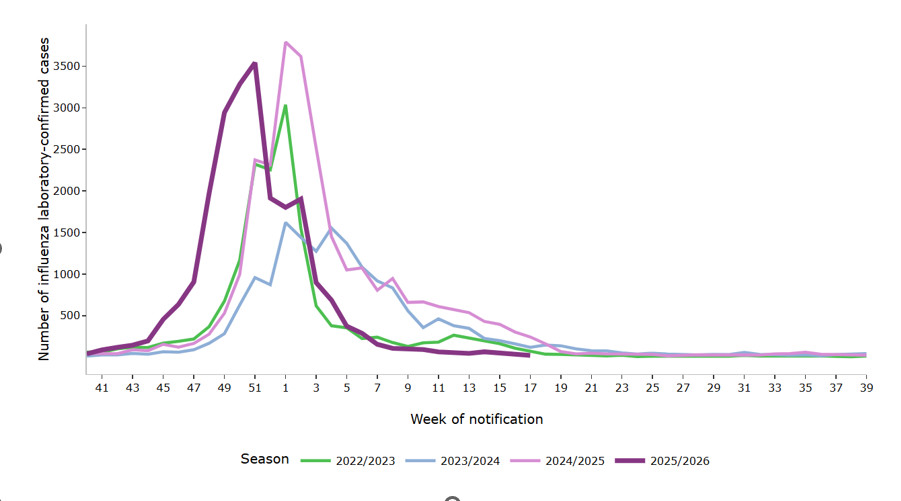
Recent data released by the Health Protection Surveillance Centre (HPSC) reflects the influenza season 2025/2026 in Ireland to date and shows that 24,948 cases were confirmed since the end of September 2025. As seen within Figure 1 the peak in numbers of laboratory-confirmed influenza cases occurred earlier in the season than in the previous season, with 3,542 cases confirmed in week 51 of 2025. Prevalence rates reduced significantly from February 2026 onwards.
Figure 1: Number of notified cases of laboratory confirmed influenza by notification week in Ireland between week 40 2022 and week 17 2026
Source: CIDR
A total of 5,919 influenza cases reported during the 2025/2026 season were hospital inpatients, including 183 confirmed influenza cases admitted to intensive care units. 291 deaths were notified. This represented a lower rate of incidence compared to the previous season. Influenza A was the predominant influenza virus circulating in Ireland in the 2025/2026 season.
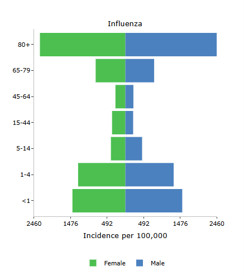
Figure 2: Age and sex-specific incidence of notified cases of laboratory confirmed COVID-19, influenza and RSV from week 40 2025 to week 17 2026.
Data source: CIDR
Figure 2 shows that age-specific rates were highest in those aged 65 years and older and that there was also a relatively high incidence in those aged four years of age and younger.
According to HSE data, over 1.3 million influenza vaccinations (IIV, LAIV) were administered across all sites (community pharmacies, GPs, hospitals, and other sites) in Ireland during the 2025/2026 influenza season. Over 474,000 influenza vaccinations (35 per cent) were administered by community pharmacists. This showed a significant increase in activity from previous years. For example, during the 2024/2025 season community pharmacists delivered c386,000 influenza vaccines (32 per cent) and c325,600 (28 per cent) in the 2023/24 season.
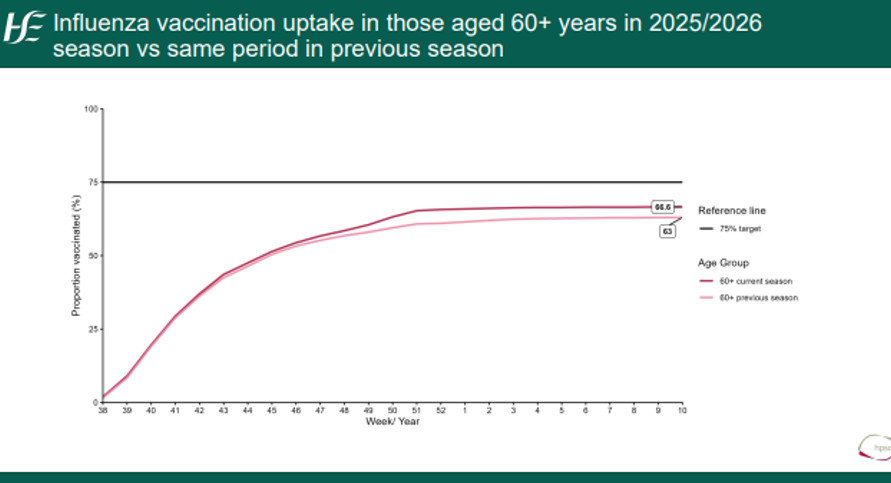
The vaccine uptake target is set at 50 per cent for children aged 2 to 17 years and at 75 per cent for those aged 60 years and over. Influenza uptake rates by age group are calculated based on the proportion of individuals in the specified age group who are vaccinated during the period 15 September 2025 to 8 March 2026.
Figure 3: Influenza vaccination uptake in those aged 60+ years in 2025/2026 season vs same period in previous season
Source: HPSC
As seen within Figure 3, adults aged 60 years and older saw rates of administration also increase from 63 per cent to 66.6 per cent.
Healthcare workers uptake is an area of focus and concern with rates improving slightly from 32 per cent to 34.6 per cent.
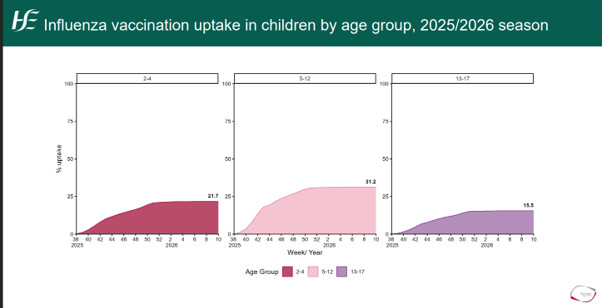
Vaccination uptake for children aged 2 to 17 years improved for the most recent season with vaccination rates increasing from 20.3 per cent during the 2024/2025 season to 24.6 per cent. Figure 4 shows the uptake in children by age group. It clearly demonstrates that the vaccine administration rates within the 5-to-12-year age group has experienced a considerable rise to 31.2 per cent from 26.5 per cent the previous year, which can be attributed to the LAIV Schools Programme. Those aged 2 to 4 years and 13 to 17 years show much lower uptake rates of 21.7 per cent and 15.5 per cent respectively.
Figure 4: Influenza vaccination uptake in children by age group, 2025/2026 season
Source: HPSC
Children’s LAIV nasal spray is provided as a service within the retail pharmacy setting and also through the LAIV Schools Programme which commenced during the 2023/2024 season. 1,361 pharmacies provided an LAIV service. The HSE National Immunisation Office (NIO) once again encouraged and facilitated community pharmacies, GP practices and HSE teams to link with local primary schools to provide on-site LAIV to children in all year groups in a school where possible. HSE vaccination teams offered LAIV to all primary age special education schools.
During the 2025/2026 vaccination programme community pharmacy recorded administration rates of nearly 150,000 LAIV and provided in excess of 56 per cent of this vaccine type. This was in-line with the significant contribution pharmacy demonstrated during the 2024/2025 season when in excess of 127,00 LAIV were administered. This nearly doubled the administrations that were provided during 2023/2024 where community pharmacies recorded more than 78,000 LAIV and held a market share of 45 per cent. The majority of community pharmacies providing the LAIV schools service engaged with between one to five schools. Available data indicates that 57 per cent of primary schools nationally facilitated the provision of the LAIV schools programme.
As in previous seasons the NIO published a Toolkit to Support the Administration of Flu Vaccination to Children in Primary Schools or Community Settings by Primary Care to support the service. The PSI also updated their guidance. The IPU developed several resources, including a risk assessment template, which was made available on the IPU LAIV Hub. A comprehensive communications plan, which included social media and radio advertising, was developed and rolled out by the IPU to support this vaccination campaign as a result of an unrestricted grant from Astra Zeneca.
The functionality to record influenza vaccinations administered at locations outside retail pharmacy premises was introduced on HSE PharmaVax in 2025. This feature enables community pharmacists to input a temporary location such as a school. Pharmacists can search for and select the Facility ID, Name, Address, or School Roll Number in the vaccination details section of HSE Pharmavax allowing the location and number of vaccinations provided in an offsite location to be identified. The application of this functionality is being reviewed for the 2026/2027 vaccination season and it is hoped that this will be applied more broadly so that data reflecting activity within schools is fully captured.
Currently plans are being finalised for the delivery of LAIV during the 2026/27 season.
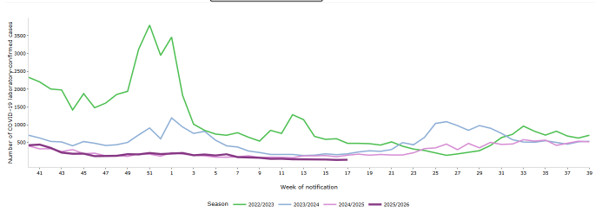
As seen in Figure 5, the number of laboratory confirmed cases COVID-19 remained low throughout the season, with 4,662 confirmed cases since late September 2025. The number of ICU admissions due to COVID-19 during the same period, was 27. The number of deaths for the same period were 94, with 87 of those occurring in those aged 65 years or older. BA. 3.2 was the predominant SARS-CoV-2 variant.
Figure 5: Number of notified cases of laboratory-confirmed COVID-19 by week of notification in Ireland, between week 40 2024 and week 17 2026
Data source: CIDR
The National Immunisation Guidelines, ‘Chapter 5a COVID-19’, was extensively revised in May 2025 reflecting the evolution of the causative virus (SARS-CoV-2) from pandemic to endemic status. The revision introduced new recommendations in relation to specific cohorts, vaccination of those who have never been vaccinated against SARS-CoV-2 infection, frequency of vaccination and the terminology used. Recommendations no longer reference booster doses, they now recommend a COVID-19 vaccine once or twice a year depending on the patient profile. NIAC recommended the preferential use of Comirnaty Omicron LP.8.1 in the Autumn/Winter COVID-19 booster programme.
NIAC guidance recommended an interval of six months following infection or vaccination but allowed for a minimum interval of at least three months since any previous COVID-19 vaccine dose or SARS-CoV-2 infection to be used where there was a need to provide early protection in certain circumstances, for example, planned immunosuppressive therapy or operational reasons. The recommendations also continued to allow for permissive vaccination and advised that one dose should be available for those aged 18-59 years without additional risk factors for COVID-19 if they chose to receive a vaccine following discussion with a healthcare provider.
1,140 community pharmacies offered a COVID-19 vaccination service, and just under 173,000 COVID-19 doses were administered during the Autumn COVID-19 campaign. More than 536,000 vaccines were administered during this campaign through all vaccination channels. Community pharmacy displayed a market share of 33.2 per cent, which was a slight increase on their performance of 31.5 per cent during the previous autumn campaign.
Throughout the year, the IPU Professional Services Team participate within the National Vaccination Programme, Pharmacy Workstream Working Group, which meets at two weekly intervals. The HSE Vaccination Primary Care Contractors (VPCC) team who co-ordinate all aspects of the national vaccination programmes, for pharmacies and GPs alike, chair these meetings. Representatives from the PSI and HSE PCRS also attend. These meetings enable the progress of the campaigns to be reviewed and any issues which may arise to be addressed in a timely manner. In November 2025 the VPCC held an engagement forum on the vaccination programmes to which IPU members were invited. Members who contributed to the forum discussed a wide variety of topics, including the National Cold Chain Service (NCCS), HSE PharmaVax, resources to support the programme and communications. The information provided at this session has been reviewed and changes implemented where possible, particularly when planning for the upcoming vaccination programme, which will commence in October 2026.
Feedback on the vaccination programmes can be provided at any stage to the IPU by emailing pharmacists@ipu.ie or to HSE VPCC by emailing Vaccinations.PrimaryCareContractors@hse.ie.
Community pharmacies continue to play a significant role in the provision of this national programme. The strong delivery of the LAIV schools programme shows yet again the profession’s ability to embrace new avenues of service provision, increase accessibility to vaccinations and support their communities.
References available on request.