





Facts on community pharmacy:
Community pharmacy is already one of the most accessible and widely used parts of Ireland’s health service. There are 1,912 community pharmacies nationwide, with approximately 2.14 million adults visiting a pharmacy each week and more than 111 million visits annually. The sector also supports more than 20,000 jobs and contributes over €1.3 billion to the economy each year.
At the same time, Government policy is placing community pharmacy at the centre of plans to deliver more healthcare closer to home. The Expert Taskforce on the Expansion of the Role of Pharmacy, the Programme for Government and the Community Pharmacy Agreement 2025 (CPA25) have all set a clear direction towards a broader clinical role for pharmacists.
CPA25 was an important milestone in this transformation and provides a strong basis for further development. The Common Conditions Service, expanded vaccination programmes, the BowelScreen programme, medicines optimisation and the introduction of a pharmacist-led contraception service, together with other initiatives, are changing the way in which pharmacy contributes to patient care.
There is significant potential to build further on these services in areas including prevention and population health, sexual and reproductive health, acute care, and medicine optimisation and patient care.
However, as outlined in our submission additional services cannot simply be layered on top of existing pharmacy workloads. ExpandeJd clinical services require dedicated pharmacist time, trained pharmacy teams, appropriate digital infrastructure, investment, and sustainable funding.
The submission comes at an important time for the sector. The statutory review of State pharmacy dispensing fees under the Public Service Pay and Pensions Act 2017 was due to commence in June 2026. The outcome of this process will determine the fees payable from 2027 onwards, making Budget 2027 particularly significant.
The economic environment facing pharmacies has changed considerably since the previous review commenced in 2023. The National Minimum Wage has increased by 25%, while average wage costs per pharmacy increased from €386,231 in 2023 to €442,044 in 2025, an increase of 14.5%. Energy, insurance, IT, regulatory and other operating costs have also continued to rise.
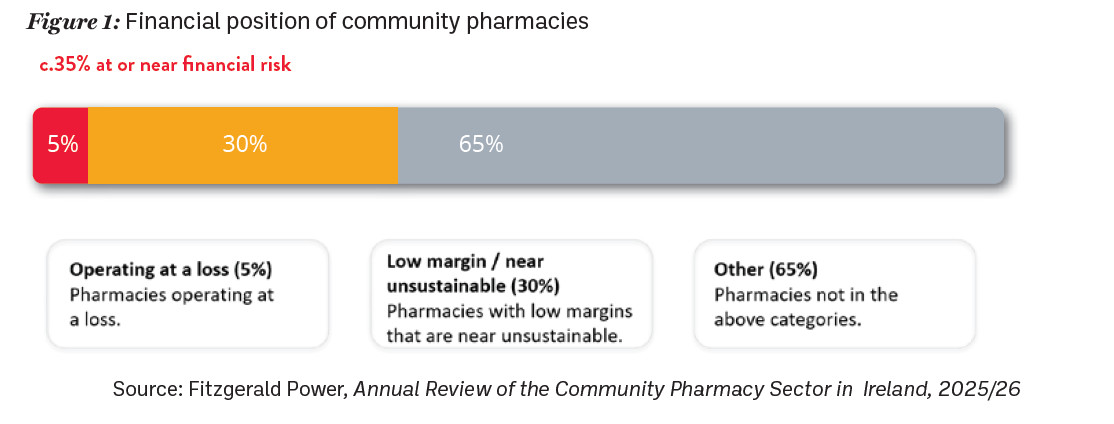
This is particularly significant because approximately 81% of dispensary activity is funded by the State. Unlike most businesses, pharmacies therefore have very limited ability to respond to rising costs through pricing. At the same time, cumulative CPI inflation since June 2023 has reached approximately 7.3%, reducing the real value of existing remuneration.
The submission, therefore, argues that the discussion around pharmacy funding should not be viewed simply as a question of increasing fees. It is about ensuring the pharmacy network has the capacity to continue providing existing services while investing in the people, technology and infrastructure required to deliver the expanded role envisaged by Government.
Figure 1: Financial position of community pharmacies
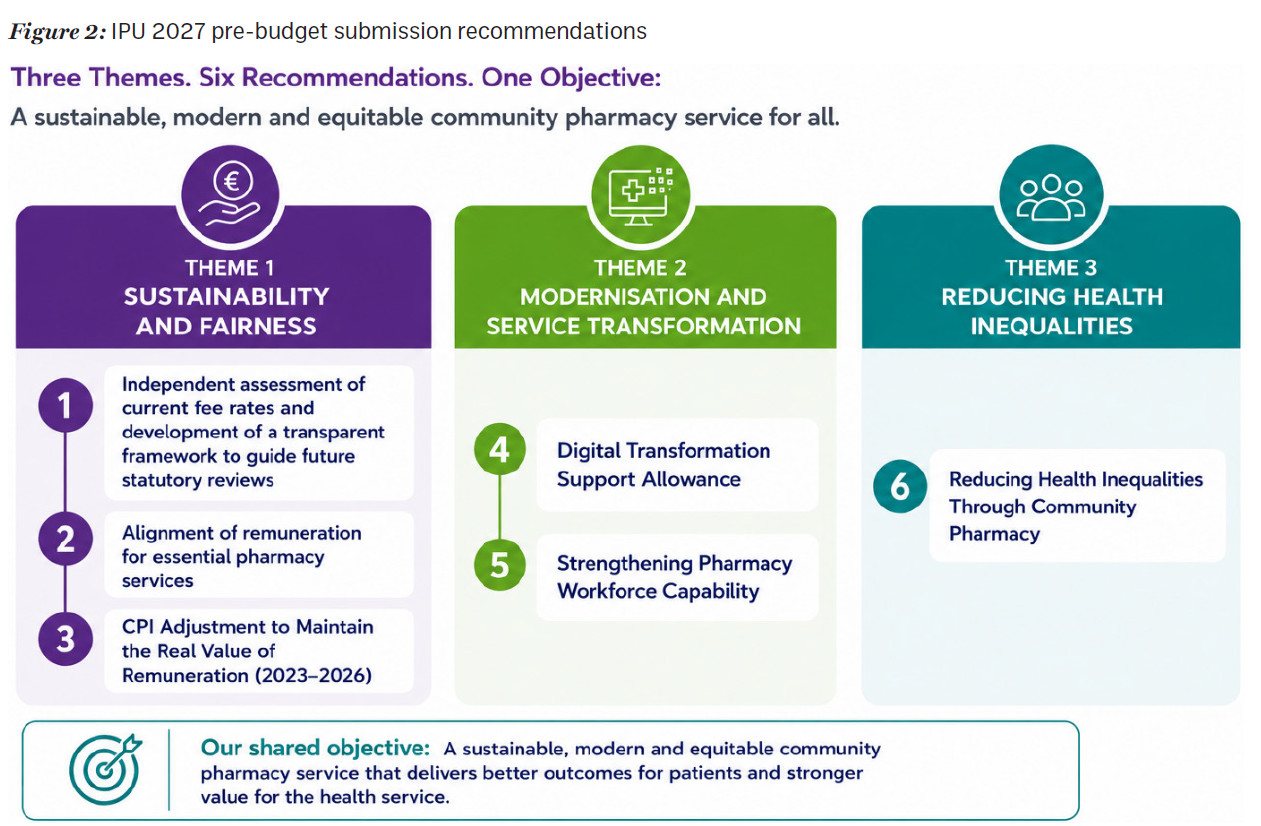
The IPU has put forward the following six recommendations under three themes:
Together, the overall cost of these recommendations requires a Budget 2027 allocation of €53.72 million.
Such a framework should take account of changes in labour costs, inflation, regulatory obligations, digital investment requirements, and other costs associated with delivering State-funded pharmacy services.
The objective is to ensure services requiring comparable levels of professional input are remunerated more consistently particularly where those services support vulnerable patients, improve medicines safety, and deliver measurable value to the wider health service.
This is not intended as a real increase in remuneration, but to protect the value of the fees already agreed as pharmacy operating costs continue to rise, thereby supporting the sustainability of community pharmacy services and ensuring that patients continue to have access to safe, high-quality care in their communities.
The support is necessary to ensure pharmacies can successfully implement new digital infrastructure while continuing to deliver safe, accessible, and high-quality patient care.
Strengthening workforce capability is essential to support the continued expansion of community pharmacy services and ensure pharmacies can meet the growing clinical responsibilities expected under Government healthcare policy.
The Government decision to provide a Social Deprivation Practice Grant of €40,000 to GPs serving the most socially deprived populations, with €35,000 for all remaining GMS GPs, recognises that State contractors facing the greatest levels of deprivation require additional support. Applying the same principle to community pharmacies is a matter of fairness and equity, ensuring that State-contracted primary care providers experiencing the same pressures are supported in the same way.
Figure 2: IPU 2027 pre-budget submission recommendations
While the funding recommendations are an important part of the submission, its central argument goes considerably further.
The recommendations are not simply investments in sustaining the existing community pharmacy network. They represent the enabling foundations required to realise Government policy for the expansion of community pharmacy. By securing a sustainable funding model and investing in workforce capability, digital infrastructure and equitable access, pharmacists can deliver a substantially broader range of clinical and public health services.
This includes prevention and population health initiatives, sexual and reproductive healthcare, enhanced common conditions care, medicines optimisation, pharmacist prescribing and wider public health interventions.
For patients, this means faster access to care, more care delivered locally, reduced travel, reduced inequalities in care provision and improved service quality.
For Government and the wider health service, it means increasing capacity at community level, reducing pressure on general practice, hospitals and waiting lists, accelerating digital transformation, and developing the healthcare workforce.
For pharmacies, it means greater business certainty, a sustainable network, and the capacity to invest in digital transformation and an enhanced clinical role.
Our submission also places a strong emphasis on equity. Pharmacies serving disadvantaged communities can face greater demands through increased dispensing volumes, more complex medicines management and greater patient support requirements. Protecting access to community pharmacy where health need is greatest is therefore not simply an issue of pharmacy sustainability; it is an important part of protecting equitable access to healthcare.
Community pharmacy has demonstrated that it is willing and able to play a greater role in the delivery of healthcare. The direction of Government policy is also clear: pharmacists are expected to provide an increasingly broad range of clinical and public health services.
Budget 2027 provides an opportunity to ensure that the financial and operational foundations are in place to make that ambition achievable.
The recommendations in the submission are not intended to be viewed as standalone funding measures. They are the necessary foundations required to sustain the existing network while enabling pharmacists to invest in the workforce, digital infrastructure, and expanded services that the future health system will require.
Investment in community pharmacy is therefore not simply about maintaining what already exists. It is about enabling the sector to deliver more for patients, increase capacity across the health service and support the Government’s objective of providing more care closer to home.
A full copy of the IPU Pre-Budget Submission 2027 is available on ipu.ie.