



By the end of this article, and following completion of the suggested action points, you should be able to:
Sports pharmacy is a growing field which has seen significant developments in a wide range of countries globally in recent years.
Turning the search engine on itself, a quick look at Google Trends shows that the volume of queries for the term “sports pharmacist” has risen by 190% over the past five years. And today’s search results show a very different picture than they would have five years ago: university programmes, an International Olympic Committee (IOC) diploma, and an annual international symposium, where previously there was little beyond scattered individual practice.
However, reaching consensus on what, exactly, “sports pharmacy” is, proved challenging. Consequently, the US Sports Pharmacy Group commissioned a taskforce to address this exact question, and in 2024 they arrived at the following definition:
‘Sports pharmacy is the specialised practice of pharmacy that focuses on the use and education of therapeutic interventions, including, but not limited to, medications and supplements to optimise physical and cognitive performance, maintain sports integrity, and support recovery for athletes and physically active individuals across all demographics.’
As with many medical definitions, this definition has a lot to unpack. To my mind, it essentially describes pharmacists using their specialist skills and expertise to help ensure the safe, appropriate, and effective use of medications and supplements in sport. This applies to patient-athletes at all skill and experience levels, from individuals beginning their fitness journey to elite sportspeople.
There are a myriad of reasons as to why interest in this specialised field of pharmacy has grown exponentially in recent years.
As the World Health Organisation outlines, when we consider an individual’s health, we consider not merely the absence of disease or infirmity, but their complete physical, mental, and social wellbeing. Sport has been proven to be beneficial to each of these aspects of an individual’s health.
I believe that all healthcare professionals have a professional responsibility to promote their patients’ engagement in physical activity and sport. Pharmacists, as highly trained and easily accessible healthcare professionals, are perfectly positioned to be at the vanguard of this promotion of physical activity.
The use of medications and supplements by patient-athletes carries inherent risks, which pharmacists are uniquely skilled to mitigate.
For those athletes operating at the elite level, there is the potential issue of inadvertent doping. The World Anti-Doping Agency (WADA) is an international, independent body whose primary role is leading a collaborative worldwide movement for doping-free sport. WADA publishes an annual Prohibited List, indicating what substances and methods are prohibited in sport.
For substances to be included on this list, they must be adjudged to meet two of the following three criteria:
It includes a wide range of substances, such as anabolic agents, growth hormones, beta-2 agonists, metabolic modulators, and more.
Any substance or method which masks the effect or detection of prohibited substances (such as a diuretic) is also prohibited. So, if we consider an elite female runner who is undergoing off-label treatment of acne using spironolactone, this medication could result in the athlete returning an adverse analytical finding (positive test) and potentially missing out on an Olympic Games or World Championships.
Additionally, any substance which has not been approved for human use is prohibited. Topically (in the metaphorical, not literal sense), the rise in the use of ‘peptides’ in numerous jurisdictions worldwide creates a potential problem for athletes who are subject to anti-doping testing as these products (for example, BPC-157) do not currently hold licenses from regulatory authorities for human use.
There are medications on the Prohibited Substance List which may be clinically necessary and appropriate for specific athletes to use. Therapeutic Use Exemptions (TUEs) provide the practical solution for athletes to use these medications without incurring an Anti-Doping Rule Violation (ADRV). The four criteria for an athlete to potentially be granted a TUE are (abridged):
Usually, TUEs are applied for and granted ahead of the use of the prohibited substance (or method), but this is not always practical (for example, in emergency situations) so athletes can also avail of retroactive TUEs in specific circumstances.
If we consider the case of a patient with confirmed type-1 diabetes mellitus, we can see that their legitimate use of insulin should not restrict their right to compete in elite sport. In such a case, all four of the above-listed criteria are met, so they should indeed be granted a TUE.
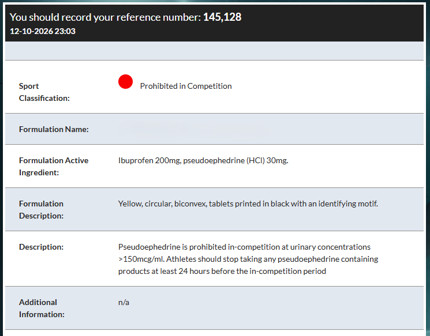
Through its National Health Products Catalogue (NHPC), the IPU plays a central role in supporting Medcheck, Sport Ireland’s online medicines-checking service for athletes, healthcare professionals and the public. By contributing its extensive medicines information expertise and supporting the ongoing maintenance of the database, the IPU NHPC helps ensure users can access accurate, up-to-date information on medicinal products available in Ireland and their status under the World Anti-Doping Agency (WADA) Prohibited List. This collaboration showcases the strength of the IPU NHPC as a national medicines information resource and highlights the IPU NHPC’s commitment to promoting safe medicine use, supporting informed healthcare decisions, and advancing Sport Ireland’s Clean Sport programme. Through this work, the IPU NHPC is helping to safeguard athlete health while demonstrating the valuable contribution of pharmacy and medicines expertise to sport and wider public health.
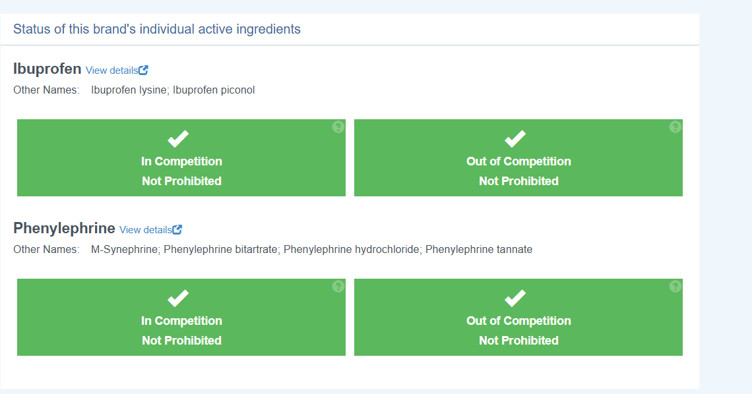
For medications that athletes obtain in other jurisdictions, such as the UK and the US, when travelling for competition, the Global Drug Reference Online database is a helpful resource for athletes and pharmacists. It works in much the same way as Medcheck and provides an auditable record of anti-doping compliance checks undertaken on OTC medications.
The issue of inadvertent doping extends beyond prescriptions medications to over-the-counter (OTC) medications and supplements.
OTC medications can also contain substances on the WADA Prohibited List. An interesting example occurred during my practice recently; an elite athlete, based in the UK, was in Ireland for a competition. They had previously used a UK cold and flu remedy containing ibuprofen and phenylephrine and had used the available resources (Medcheck and myself) to check that it did not contain any prohibited substances, and this was confirmed to be the case.
They stopped by a pharmacy in Ireland to pick up the product again and asked me to double-check that it was OK to use on the day of the competition. This product is also marketed in Ireland under the same name, but the product that is available in Ireland, instead of phenylephrine along with ibuprofen, it contains pseudoephedrine. Pseudoephedrine is included on the Prohibited List (subject to urinary concentration limits), so the use of this product could have created anti-doping problems for the athlete. We agreed on a safe, appropriate alternative.
Image 1: Global Drug Reference Online
Source: globaldro.com
Image 2: Medcheck
Source: Medcheck.sportireland.ie
The widespread issue of nutritional supplement contamination means athletes must exercise extreme caution when considering their use. As these products are not subject to the same strict regulations, athletes should only use them.
A third-party, banned-substance testing quality assurance programme, such as Informed Sport, BSCG, and NSF, among others, can test individual batches of the supplement for a defined list of prohibited substances and contaminants. Importantly, although these programmes minimise the risk of inadvertent doping with these products, they do not eliminate it completely.
It feels unacceptable to me that an athlete could miss the biggest sporting event of their career by unintentionally falling foul of anti-doping rules. In many high-profile examples across a variety of sports, one thread appears almost ubiquitous — these cases are completely avoidable. Pharmacists can be part of the athlete support system to help minimise the risk of inadvertent doping for elite athletes.
Pharmacists also have the specialist clinical skillset to assist sports healthcare professionals in reducing other risks that are associated with athletes taking medications: adverse drug reactions (ADRs) and negative impacts on performance.
Unlike inadvertent doping, these risks exist for athletes at all levels. Let’s consider the ‘weekend warrior’ who has begun their fitness journey and is preparing for their first 5km run. They are suffering from allergic rhinitis and, knowing and trusting you as their local community pharmacist, they drop in to pick up antihistamines ahead of the race, and have requested chlorphenamine tablets. At this point, as part of your consultation, you can include some open-ended questions to get the full picture, for example:
With this full picture, we can potentially steer the patient away from sedating chlorphenamine to an appropriate non-sedating alternative and avoid any negative impacts on the runner’s performance. This may not be groundbreaking or require specialist training, but it is a small intervention that can benefit the patient and requires only the communication skills and well-earned patient trust that pharmacists already have in abundance.
There are endless other scenarios involving other conditions and medications where pharmacists can apply their medication expertise to help minimise the risk of ADRs and negative impacts on performance (for example, appropriate use of NSAIDs, selection of the optimal form of iron in iron-deficiency anaemia, etc.).
One important consideration is around the use of antibiotics for athletes. Fluoroquinolones are associated with an increased risk of tendonitis and tendon rupture (particularly, but not limited to, the Achilles tendon). For physically active patients, this is a potentially serious side effect, and for professional athletes, the risk extends not only to their physical health, but to their career and livelihood as well.
The roles sports pharmacists play are evolving and expanding. My role with MedsOnTrack focuses on the systems and governance around medication usage in elite sport, including medication tracking, data analysis, and providing clinical insights to multidisciplinary medical departments.
In community pharmacy, sports pharmacists can provide clinical guidance on the safe, appropriate use of medications by athletes and active individuals. Anti-doping agencies worldwide employ and value multiple sports pharmacists for their understanding of medications. In elite sports, sports pharmacists are beginning to become embedded into sports medical departments, providing medication use reviews to teams and managing athletes’ medications.
References available on request.
About the author: Colin Ryan is a graduate of the RCSI School of Pharmacy, where he now leads an elective module in sports pharmacy. He works with MedsOnTrack, assisting professional sports teams in Ireland and the UK with their medicines management. Contact via colin@MedsOnTrack.com.
Interested in learning more?
Many jurisdictions globally are increasingly including sports pharmacy in undergraduate pharmacy education, including an elective module at the Royal College of Surgeons in Ireland.
The University of Southern California and the University of Mississippi both offer certificate programs for postgraduates, while other organisations, such as the Sports Pharmacy Network, offer their own courses on the topic.
The IOC has developed a diploma course, the first Sports Pharmacy programme accredited by the International Pharmaceutical Federation (FIP).
As a starting point, if interested in learning more about the topic, there are two free online courses which are informative and provide a solid foundation for future learning in the area: