


Home » A menopause and heart health resource for women with intellectual disabilities
When most people think about heart disease, they often picture a man clutching his chest during a heart attack. However, heart disease affects women just as much as men, particularly after menopause.
Before menopause, women benefit from the protective effects of oestrogen, which helps reduce the risk of heart disease. As women approach menopause and oestrogen levels begin to decline, this protection gradually decreases. As a result, a woman’s risk of developing heart disease rises and eventually becomes similar to that of a man.
This makes menopause a particularly important time for women to learn about heart health and understand the steps they can take to reduce their risk.
Heart disease remains one of the leading causes of death and disability in Ireland. In fact, one in four women dies from heart disease, the same proportion as men. The encouraging news is that up to 80% of premature heart disease cases can be prevented through healthy lifestyle changes such as stopping smoking, eating healthily and moving more.
The Irish Heart Foundation is committed to helping people across Ireland protect their heart health through information, education and support. Since 2022, we have delivered Her Heart Matters, a national awareness and behaviour-change campaign focused on women’s heart health. In 2025, support from the Department of Health’s Women’s Health Fund enabled us to expand the campaign and increase our focus on marginalised groups of women.
As part of this work, we identified women with intellectual disabilities as a group facing particular challenges in relation to both menopause and heart health.
In Ireland, approximately 110,000 people (2% of the population) have an intellectual disability, with around 34,600 people attending disability day services.
Research from IDS-TILDA Wave 5 found that women with intellectual disabilities typically experience menopause earlier at around age 48, compared with an average age of 51 in the general population. For women with Down syndrome, menopause occurs even earlier, at approximately 44 years of age.
The research also found that fewer than half of women with intellectual disabilities know what menopause is or can recognise its symptoms. This lack of awareness may contribute to broader health inequalities, including an increased risk of death from heart disease and stroke among people with intellectual disabilities.
Recognising these gaps, the Irish Heart Foundation set out to develop a resource specifically designed to help women with intellectual disabilities understand menopause and its impact on heart health.
The evidence clearly showed that a tailored resource was needed. However, we also knew that creating an effective resource would require more than simply adapting existing information.
At the Irish Heart Foundation, we strongly believe in co-design. The people who will use a resource should be actively involved in creating it. Their insights and experiences are essential to ensuring that the final product is accessible, relevant and useful.
While we had expertise in heart health, we had limited experience working directly with people with intellectual disabilities. We therefore sought the support of organisations with specialist knowledge and established relationships within the community.
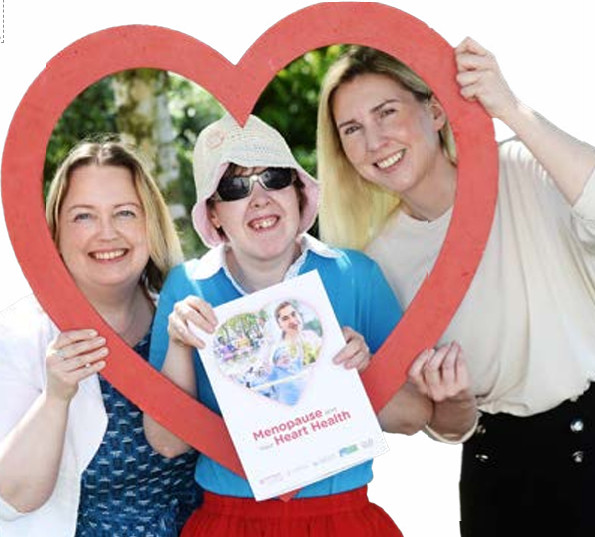
To bring this project to life, we partnered with Inclusion Ireland and Ability West to co-produce a new Easy Read resource called Menopause and Your Heart Health.
The resource was designed specifically for women with intellectual disabilities and aims to explain how menopause affects heart health, while providing practical advice on how to keep the heart healthy.
The resource was developed through three co-production workshops involving disability day service users in the Midlands and Galway.
These workshops gave participants a meaningful opportunity to shape the content. Women shared what information they felt was important, how they wanted it presented, and what language, images and formats worked best for them.
Working alongside Inclusion Ireland and Ability West helped us build trust with participants and learn new approaches to engagement and facilitation. Their expertise was invaluable in creating productive and inclusive workshops.
Most importantly, the workshops ensured that the voices of women with intellectual disabilities were at the centre of the project. Their feedback directly influenced the topics covered, the tone of the content, the design of the resource and the choice of imagery.
The final resource is presented in an Easy Read format.
Easy Read uses clear, straightforward language and supports each idea with a meaningful image. This approach helps people with learning disabilities and others who may find standard written information difficult to understand.
The goal is to make information more accessible, engaging and easier to use.
One of the most valuable lessons from the workshops related to imagery.
We tested a range of images with participants and quickly discovered that traditional stock photos were not always effective in supporting understanding or engagement. Participants responded much more positively to images that reflected people like themselves and their everyday experiences.
As a result, we invested in a licence for Photosymbols, a specialist image library featuring people with a range of disabilities participating in everyday activities. With over 13,000 images available and new content added regularly, Photosymbols became an important resource for developing inclusive and meaningful visual content.
Another key insight from the workshops was the importance of taking a modular approach to learning.
Participants told us that understanding the relationship between menopause and heart health required a strong foundation first. Before exploring the connection between the two, they needed to understand what menopause is and gain a basic understanding of heart health.
This informed the structure of the resource:
Part 1: Understanding the basics
Introduces key words and concepts related to menopause and heart health.
Part 2: Understanding the connection
Explains how menopause can affect heart health and why the risk of heart disease increases after menopause.
Part 3: Taking action
Provides practical information on lifestyle changes that can help protect heart health.
By building knowledge gradually, the resource helps learners develop confidence and a deeper understanding of the topic.
We encourage disability day service staff, speech and language therapists, advocacy workers and adult literacy practitioners to use this modular approach when delivering education sessions on menopause and heart health.
By breaking down the information into manageable stages, facilitators can support women with intellectual disabilities to better understand menopause, recognise its impact on heart health and feel empowered to take positive steps towards a healthier future.
For more information about taking care of your heart health, please visit irishheart.ie.
References available on request.
Gayatri Koshy

Health Information Manager, Irish Heart Foundation
Highlighted Articles