




October is breast cancer awareness month
Key points:
Cancer is Ireland’s leading cause of death. It is estimated that one in two people in this country will be diagnosed with cancer at some point in their lives in this country. Diagnosing cancer as early as possible is critical to achieving higher survival rates, reducing treatment severity, and improving the quality of life of patients.
Most cases of breast cancer occur in females, with just 1% occurring in males. Although it primarily affects older females, it is important to note that 39% of cases of breast cancer occur in women aged under 54 years. Annual numbers of breast cancer cases are projected to increase by 50% between 2015 and 2045.
Most cases of breast cancer in Ireland (75%) are diagnosed at an early stage (stage I or II) when survival rates are high at 99% and 94% respectively (see Figure 1 below).
Figure 1: Five-year survival for breast cancer by stage at diagnosis

While breast cancer can occur in anyone, at any age, certain factors can increase the risk of the disease developing.
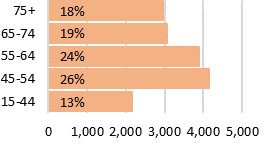
Age: Increasing age is associated with increased risk of breast cancer. However, it is important to note that even young women may develop breast cancer. The age profile of breast cancer in Ireland is shown in Figure 2.
Figure 2: Breast cancer cases diagnosed 2014-2018, percent by age at diagnosis
Family history: About five to 10% of breast cancers are thought to be caused by a cancer-causing gene (for example, BRCA1, BRCA2, TP53, PALB2). In addition, some families have a strong family history of breast cancer, even in the absence of a known cancer-causing gene. Important factors in family history include: one or more relatives (particularly at a young age); family history of breast cancer in males; and family history of ovarian cancer.
Alcohol consumption: Alcohol consumption is thought to account for 7.5% of cases of breast cancer, or about 223 cases annually. Alcohol consumption, even at low levels, increases the risk of breast cancer — there is no ‘safe’ level of alcohol consumption.
Medication: Approximately 4% of breast cancers are thought to be attributable to Hormone Replacement Therapy.
Other risk factors include:
Breastcheck (breastcheck.ie) is Ireland’s breast cancer screening programme. Breastcheck aims to detect breast cancer at an early stage when it is potentially curable. About one-third of breast cancers in Ireland are diagnosed via Breastcheck.
Between the ages of 50 and 69 years, all females, trans-males who have female breast tissue, and trans-females who have been taking feminising hormones for at least five years, are offered a mammogram free of charge every two years. If a mammogram shows an abnormality, women will be invited to their local breast clinic for further assessment and/or biopsy.
Attendance at Breastcheck should be encouraged, particularly in older females; uptake of Breastcheck screening is highest in the 50-54 year age cohort at 72.6% but falls to just 28.1% in the 65-69 year age cohort. Patients can check that they are on the Breastcheck register by logging on to breastcheck.ie or by telephoning 1800 45 45 55.
Women are advised to check their breasts regularly and to be ‘breast aware’. Being ‘breast aware’ means knowing how your breasts look and feel, and what is normal for you, so that if there is a change in your breast, you will notice. There is no ‘right’ or ‘wrong’ way to check the breasts — the most important thing is to check regularly. HSE guidance on breast self-examination is available at 2.hse.ie/conditions/how-to-check-your-breasts.
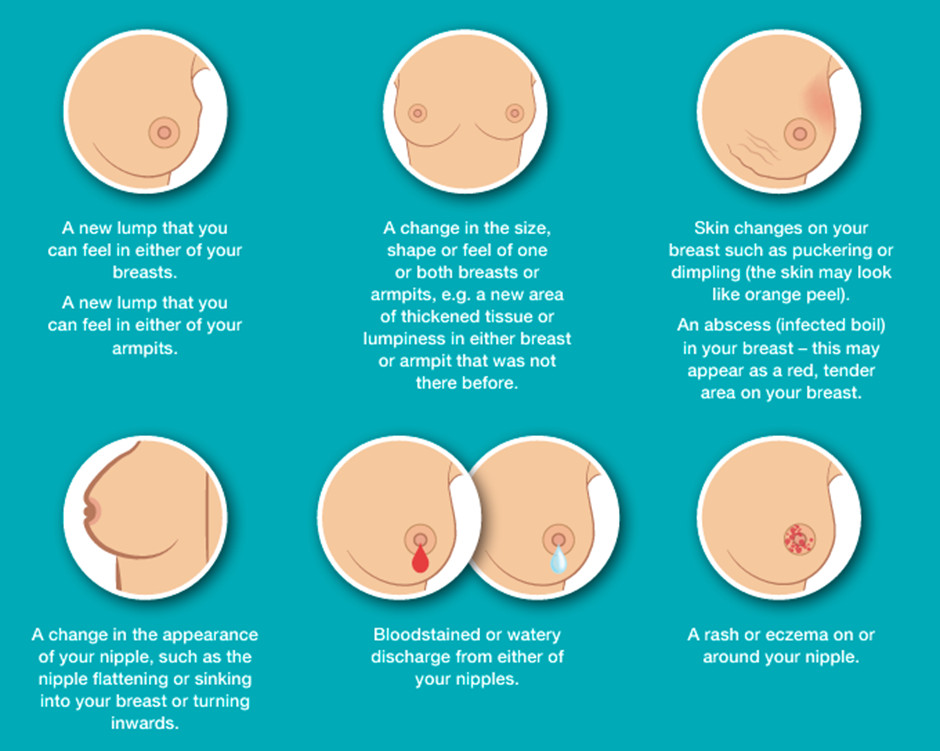
Signs and symptoms of breast cancer are shown in Figure 3 and may include:
Figure 3: Signs and symptoms of breast cancer
People with signs or symptoms suggestive of breast cancer should be advised to contact their GP as soon as possible. GPs can refer patients with suspected breast cancer electronically to one of Ireland’s National Symptomatic Breast Disease Clinics.
There are nine Symptomatic Breast Disease Clinics in Ireland: Beaumont Hospital, Dublin; Cork University Hospital; Letterkenny University Hospital; Mater Hospital, Dublin; St. James’s Hospital, Dublin; St. Vincent’s University Hospital, Dublin; University Hospital Galway; University Hospital Limerick; and University Hospital Waterford.
Treatment of breast cancer depends on the type of breast cancer, the location, the spread and the person’s general health, but in general, has the following components:
After a cancer diagnosis, healthy lifestyle is crucial.
It is never too late to quit smoking. Smoking cessation support, including Nicotine Replacement Therapy, are available free of charge to all adults, even those without a GMS card by contacting quit.ie.
Support to quit alcohol can be found at askaboutalcohol.ie.
Everyone with a diagnosis of cancer is advised to undertake between 2.5 to five hours of moderate intensity aerobic physical activity weekly; or 1.25 to 2.5 hours of vigorous intensity aerobic physical activity per week, in addition to muscle strengthening activities that involve all major muscle groups on two or more days per week. Physical activity does not have to be avoided due to fatigue.
In terms of ongoing medical care, breast cancer survivors may be at increased risk of osteoporosis, cardiovascular disease, and should be encouraged to contact their GP if they develop symptoms.
Many women with breast cancer will remain sexually active. Specialist support may be required if they wish to conceive. If not, they can be offered non-hormonal contraception.
Support services for people diagnosed with cancer are available free of charge through the National Cancer Control Programme network of Community Cancer Centres. These centres offer support not just to patients with cancer, but also to family members, including children. A full list of Community Cancer Centres can be found at hse.ie > Conditions > Cancer > Support centres.
Overall five-year net survival for breast cancer has increased in Ireland from 72% in those diagnosed from 1994 to 1998 to 88% in those diagnosed from 2014 to 2018. Increases in survival have occurred across all age groups. At the same time, breast cancer mortality rates are declining significantly by 1.8% per year (although total number of breast cancer deaths are increasing due to increasing incidence).
Breast cancer is the commonest invasive cancer in females in Ireland, but mortality from breast cancer is decreasing and long-term survival is increasing.
References available on request.
Most patients will begin their cancer journey in primary care. We must continually strive for earlier diagnosis of cancer, to minimise the burden of cancer in our society and achieve better outcomes for our patients.
The NCCP has developed a suite of resources for the public and healthcare professionals to help increase awareness of cancer. These include an ‘Early Diagnosis of Cancer’ e-learning module and ‘Reduce your risk of Cancer’ e-learning module on HSELand (hseland.ie). These are available free of charge and can be accessed by clicking on the ‘Cancer’ tab on the HSELand website.
The Irish Institute of Pharmacy (IIOP) have created a Cancer Care Hub, created for pharmacists in collaboration with the National Cancer Control Programme (NCCP). This resource signposts pharmacists to information to support patients in the prevention, early detection, treatment and navigation of life after cancer.
Cancer-related posters, leaflets, and information booklets are available on healthpromotion.ie. These can be downloaded and printed, or alternatively, hard copies can be ordered and delivered free of charge.
Further resources:
IPU Review articles (available to IPU Members at ipu.ie/ipu-review > Previous Articles):
Webinar: