




Obesity management in Ireland is currently undergoing a significant shift. Alongside behavioural interventions and bariatric surgery, pharmacotherapy is now recognised as an important component of evidence-based obesity management for appropriate patients. The introduction and rapid uptake of GLP-1 receptor agonists has transformed the treatment landscape, offering levels of weight loss not previously achieved with earlier medicines. Medicines currently licensed for obesity management in Ireland include liraglutide (Saxenda), semaglutide (Wegovy) and tirzepatide (Mounjaro), while several other incretin-based therapies are licensed for the management of type 2 diabetes.
For community pharmacists, the impact of these medicines extends far beyond the number of prescriptions being issued. These medicines are changing the conversations taking place every day in community pharmacies across Ireland. Pharmacists are increasingly answering questions about treatment, managing medicine shortages, addressing misinformation, supporting adherence and helping patients navigate what can be a complex treatment journey. Pharmacists are often managing patient expectations about what these medicines can, and cannot, achieve.
To better understand how this changing landscape is affecting everyday practice, we conducted the first national survey of community pharmacists in Ireland examining the use of GLP-1 medicines for treating obesity. The survey combined questions with opportunities for pharmacists to share their own experiences and perspectives, providing both quantitative data and qualitative insights into current obesity management practice.
Two hundred community pharmacists, representing a broad range of professional experience and pharmacy settings, shared their perspectives on current practice, patient counselling, barriers to providing support and the future role of community pharmacy in obesity management.
The findings showed that pharmacists recognised the important contribution community pharmacy can make to obesity management and described a role that extends well beyond the supply of medicines. However, there is a significant gap between the care pharmacists want to provide and what current systems enable them to deliver.
Education and training, protected consultation time, reimbursement, access to clinical information and stronger integration with multidisciplinary obesity services were identified as key priorities.
The findings from our survey suggest that the GLP-1 consultation has become considerably more complex than a routine prescription handover.
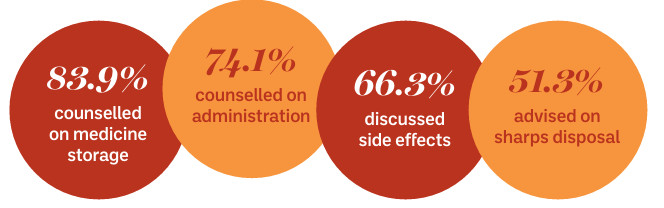
Our findings show the extent of the practical counselling that is already taking place on factors including medicine storage (83.9%), administration (74.1%), side effects (66.3%) and safe sharps disposal (51.3%). Pharmacists also reported high levels of confidence in providing advice on these topics, reflecting their key role in supporting the safe and effective use of GLP-1 medicines.
Pharmacists also described how managing expectations had become an increasingly important part of the patient conversation. Pharmacists described encounters with patients expecting rapid weight loss or viewing GLP-1 medicines as a ‘quick fix’, highlighting the need to reinforce that these medicines work best alongside healthy eating and longer-term behaviour changes. These conversations are vital, as community pharmacists will be one of the healthcare professions that patients encounter most often throughout their treatment journey.
Our findings also identified areas where further support for pharmacists could strengthen patient care. While practical advice about medicines was common, discussions about nutrition and reproductive health occurred less frequently. Notably, 45.6% of pharmacists reported that they never routinely discussed contraception with women prescribed GLP-1 medicines for obesity. Confidence was also lower for counselling on contraception.
As increasing numbers of women of reproductive potential access GLP-1 medicines, community pharmacists are well placed to reinforce counselling on contraception, pregnancy planning and the safe use of these medicines. Pharmacists will need education and professional guidance to support these consultations.
There is considerable appetite within the pharmacy profession to contribute further in this area. More than 70% of respondents agreed that community pharmacists are well placed to support people living with obesity and that GLP-1 medicines represent an appropriate treatment option for eligible patients. However, participants were equally clear that expanding this role would require changes to the systems that support community pharmacy.
In the open text responses, time was the most frequently reported barrier, identified by 85.5% of pharmacists. This was followed by a lack of dedicated or protected time for patient counselling (63%), the absence of clear professional guidance (53%), limited education and training (39%), and a lack of access to medical records (38%).
Pharmacists described how current reimbursement structures do not adequately recognise the time required for counselling, medicines optimisation and ongoing patient support. Others highlighted the lack of access to shared patient records as a significant limitation, making it difficult to understand a patient’s wider clinical picture or verify eligibility for treatment, particularly where BMI forms part of prescribing criteria.
Participants also recognised that obesity management cannot be delivered in isolation. They described the need for stronger integration with GPs and specialist obesity services to ensure coordinated, multidisciplinary management.
The rapid expansion of GLP-1 medicines has created new opportunities for patients, but it has also introduced challenges that many community pharmacists had not previously encountered.
Medicine shortages were one of the most significant practical challenges. In the open text responses, more than a third of pharmacists reported that shortages increased their workload (35%), while almost one-third (29%) described increased conflict or difficult interactions with patients, and 21% reported that shortages contributed to increased workplace stress. Pharmacists described spending considerable time sourcing alternative stock, communicating with prescribers and reassuring patients whose treatment had been interrupted.
Participants also raised concerns about the growing use of online prescribing services, including the potential for inappropriate prescribing, insufficient medical oversight and limited communication between online prescribers and community pharmacists.
The study also highlighted the continuing challenge of discussing obesity itself. Despite greater recognition of obesity as a chronic disease, stigma remains common. Pharmacists also highlighted the significant treatment cost and requests for GLP-1 medicines outside licensed indications as additional challenges in everyday practice.
The findings from this study show that community pharmacists are already making an important contribution to obesity management by providing education, medicines optimisation and ongoing support to people using GLP-1 medicines.
Education emerged as one of the strongest priorities in our research. Pharmacists identified a need for additional training in obesity management, nutrition, behavioural support and the safe use of GLP-1 medicines. When asked who should lead future education, almost 80% identified professional organisations such as the IPU, PSI and IIOP, followed by self-directed and structured CPD (49%) and HSE-delivered education (47%).
However, education alone cannot be viewed as the complete solution. Throughout the study, pharmacists highlighted the need for protected consultation time, clearer professional guidance, appropriate remuneration, access to shared clinical information and stronger integration with the wider multidisciplinary team.
The introduction of GLP-1 medicines has undoubtedly transformed obesity management, but medicines alone are not the solution. Long-term success depends on informed patients, longer-term behaviour change and coordinated multidisciplinary management. Community pharmacists are uniquely positioned to contribute to each of these areas through their accessibility, medicines expertise and frequent contact with patients throughout treatment. The challenge now is ensuring that education, professional guidance, healthcare policy and service development evolve at the same pace as clinical practice. The current national Model of Care for the management of obesity does not reference community pharmacists. Policy updates should integrate community pharmacists into national obesity management pathways. Obesity management is multidisciplinary, and community pharmacy has an important role to play.
Further information and resources: