



The vaccines supplied by the National Cold Chain Services (NCCS) as part of the autumn winter programme sees one significant change since last year. In addition to vaccines supplied during last year’s programme, Live Attenuated Influenza Vaccine (LAIV) Fluenz and standard Inactivated Influenza Vaccines (IIV), Influvac and Vaxigrip, this year there has been the introduction of an enhanced, adjuvanted inactivated influenza vaccine (aIIV) Fluad. Fluad vaccine is recommended for those aged 65 years and older. This older cohort benefits from an enhanced vaccine because the immune system becomes less effective with age, increasing the risk of severe influenza, hospitalisation and death. Fluad contains the MF59 adjuvant designed to produce a greater, broader, and longer immune response.
The National Immunisation Advisory Committee (NIAC) recommend that the preferred COVID-19 vaccine is the antigenically updated mRNA vaccine. The vaccine recommended for use within the COVID-19 vaccination programme this winter, for those aged 12 years and older, is Comirnaty XFG 30 micrograms.
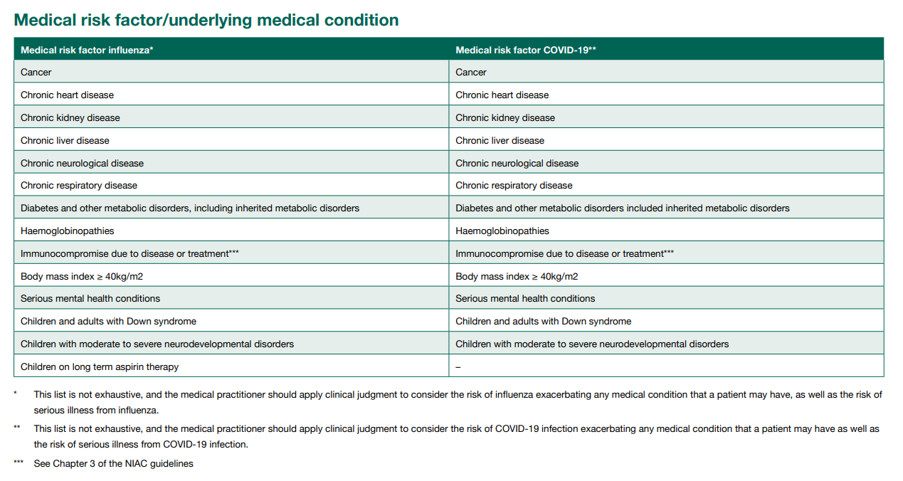
Those recommended and eligible to receive influenza and COVID-19 vaccines during this seasons vaccination programme have remained unchanged on last year.
Figure 1. Summary of groups recommended to receive influenza and COVID-19 vaccines in autumn/winter 2026/2027
In 2025, the PSI made changes to the training requirements pharmacists are required to undertake to be deemed competent to administer vaccines.
All pharmacists must self-assess on an annual basis whether they are competent to safely administer vaccines and/or medicines, as part of an overall annual self-assessment. The PSI have a self-assessment tool available in relation to vaccinations and emergency medicines.
Flexibility was introduced relating to the requirement for pharmacists to repeat the ‘Medicines Administration (Parenteral) Training Programme (PAMT)’. This training programme is repeated in circumstances where a pharmacist has had a two-year break in vaccination practice or longer as opposed to 12 months as it was previously. This aligns with the requirement to repeat ‘CPR’ and ‘Responding to an Emergency Situation including the Management of Anaphylaxis (RESMA)’ training every two years.
In-line with CPD requirements and the PSI Code of Conduct, pharmacists are required to use their professional judgement to determine the limits of their competence and when they need to undertake additional training or update their skills.
Vaccine specific training on the administration of vaccines is no longer mandatory, but is recommended. Guidance from the PSI advises that pharmacists are required to have up-to-date knowledge on any vaccine which is administered and can meet the training requirements in this regard by completing the specific training modules where available, and/or through review of, or having up-to-date knowledge in, the relevant National Immunisation guidelines for Ireland, the Summary of Product Characteristics (SmPC) for the vaccine and HSE guidance (where applicable). The ‘Administration of Influenza Vaccine Training Programme for the 2026/27 Season’ is available on the IIOP website and the ‘mRNA COVID-19 Vaccine Formulations for People Aged 6 Months and Older’ training module is available on HSeLand.
The IIOP has a ‘Vaccination Training Identification Tool’ which is intended to guide and support in identification of pharmacists training requirements for the supply and administration of vaccines. The tool is applicable to influenza, COVID-19, pneumococcal and shingles vaccines.
You will find more information in the ‘Vaccinations Training’ section on the PSI website.
Since the introduction of the LAIV Schools Programme in 2023, the rates of administrations of LAIV to children aged two to 17 years, and particularly those aged five to 12 years, have increased significantly. Uptake rates in those aged two to 17 years increased to 24.3% in the 2025/26 season from 20.1% in the previous season. For those aged five to 12 years, vaccination uptake was 30.8% last season demonstrating the positive impact of the primary schools programme. Community pharmacists have played a key role in this progress delivering over 56% of LAIV vaccinations during the 2025/26 programme. However, overall LAIV uptake is still below the HSE target of 50%, highlighting further efforts required to improve vaccination rates in this cohort.
There are two key pieces of guidance which should be referred to when planning for this service, PSI Guidance to Support Pharmacies in Providing Safe Vaccination Services Offsite from the Pharmacy Premises and the HSE Toolkit to Support the Administration of the Live Attenuated Influenza Vaccine (LAIV) Fluenz nasal spray suspension to Children in School or Community Settings by Primary Care.
The PSI guidance highlights the importance of good governance and takes into account the additional complexity, operational and workflow considerations involved in offsite vaccination services, such as school settings. Prior to providing a vaccination service at an offsite location, the superintendent pharmacist must ensure, amongst other aspects, that a robust risk assessment has been undertaken. Carrying out a risk assessment will enable you to identify hazards and key considerations. It is an essential part of the planning process to ensure a safe and efficient service is delivered. The IPU has developed IPU Guidance and Template Risk Assessment for Off-site Vaccination in a Primary School Setting to assist members. This is available on the IPU LAIV Hub.
Within the HSE Toolkit to Support the Administration of Flu Vaccination to Children in Primary School, it is outlined that the HSE expect:
This infers that where the composition of a pharmacy team to provide this service at a school does not need to include two community pharmacists, the team must comprise of at least one community pharmacist and an appropriately trained healthcare worker working under the clinical governance of the pharmacist. A key requirement of the healthcare workers role is to support the community pharmacist in the identification and management of anaphylaxis should it occur.
It is advised that the healthcare workers undertake the IPU Professional Academy module ‘Anaphylaxis Identification and Management for Healthcare Workers’. The aim of this training module is to provide community pharmacy-based healthcare workers with the skills and knowledge to enable them to identify and manage anaphylaxis while working under the clinical governance of a trained vaccinating pharmacist, particularly when delivering a school based LAIV clinic. It is also advised that the healthcare worker have a valid certificate in Cardiopulmonary Resuscitation (CPR) in line with the requirements outlined at iiop.ie/cpr-training-information.
The most up-to-date Nasal Flu Vaccination Consent Form is ‘Version 4’, which was published in September of this year. Pharmacists should ensure that all consent forms are reviewed in advance of the vaccination clinic before attending the school. The HSE advise that vaccinators do not accept consent forms given to them on the day of vaccination as this does not allow sufficient time for review. The form now includes a tick box which asks the vaccinator to confirm that the individual’s vaccination records have been checked in advance of administrations. Checking each child’s vaccination status on HSE Pharmavax as close to the time of administration will help to mitigate against duplicate vaccination within the same season. Timely and accurate recording of all vaccinations is also strongly encouraged as it essential to maintain up-to-date records and support safe service delivery.
Pharmacists can order an LAIV School Pack, which contains a Factsheet for Parents and Guardians, LAIV Consent Form and an information leaflet, from healthpromotion.ie (the order code is HNI01730). All documents relating to the LAIV programme are easily accessible on the IPU LAIV Vaccination Hub available at ipu.ie > Professional > Vaccines and Injectables > LAIV Vaccination Hub.
The IPU has received an unrestricted grant from AstraZeneca to support the Children’s LAIV Vaccination Programme. The campaign, which includes radio advertising and social media activity, aims to increase awareness amongst parents and legal guardians of the Children’s LAIV Vaccination Programme and the service provided by community pharmacists. The campaign will commence in October and continue throughout November. Videos for use in-store on pharmacy screens and statics for social media activity can be downloaded by members on the IPU LAIV Vaccination Hub. There has also been a patient facing webpage created, which is available at ipu.ie/childrens-nasal-flu-vaccine.
The Autumn Winter Vaccination Programme was identified as a priority national health promotion campaign which will be supported as part of the Community Pharmacy Agreement 2025. The HSE has shared a Winter Vaccination Programme Pack, which is available on the IPU Vaccination Hubs.
The pack contains an overview of the advertising campaign the HSE have planned including target audiences, messaging and materials. There is a particular focus on those aged over 60 years, those who are immunocompromised, the children’s flu vaccine and vaccines in pregnancy.
Additionally, there are a number of materials available for pharmacists to order from healthpromotion.ie to support their vaccination clinics. You should ensure you are logged in to see all orderable materials, as some may be restricted to account holders. Materials include vaccine leaflets, record cards and algorithms. These materials may be available to order and/or download.
PharmaVax is continuously reviewed and enhanced to support the accurate and efficient recording of vaccinations. When carrying out clinics off site, including LAIV vaccination clinics, it may be useful to use a two-tab approach when inputting patients having a vaccine administered at a clinic, such as a primary schools vaccination session. In Google Chrome, right click on an open tab and select ‘Duplicate’ to open another active tab. Use one tab for the ‘List Clients’ screen to show a list of school children, for example, and then use the second tab for ‘Add Vaccinations’. Copy and paste the PPSN from ‘List Clients’ into the ‘Add Vaccinations’ screen search bar, to quickly load the Add Vaccination screen for the selected child. Repeat for each child in the class.
It is also advisable to find the school in Facility Search bar at the bottom of the ‘Add Vaccination’ screen for these clinics. Once the correct school has been found, note down the Facility ID or School Role Number on paper if you need to search for the school again. Once the school has been set as the vaccination facility using the ‘Set as Temp Vaccination Location’ then use the ‘Add Vaccination’ screen to enter all the vaccinations for a school using the two-tab approach above. The location of the school will be recorded as the default if the ‘Save and add another vaccination’ button is used to save each record.
Recent changes to the system make notifications visible to users via the ‘notifications’ area on the home screen. New notifications will appear periodically, so you should check for new notifications on login.
The ‘Risk Factors’ have now been replaced by a new field called ‘Indications for Vaccination’. The potential options within this field have been reduced considerably from 40 to six. A new obligatory healthcare worker question is now included. Pharmacists should select all indications for vaccination that are applicable to the client. Some of these will be auto populated and some will be excluded, based on age or other criteria.
Software releases for PharmaVax will now be scheduled to occur from 8.30am to 9.30am, usually on a Thursday. At the time of printing, the following dates 01/10/2026, 22/10/2026, 12/11/2026, 10/12/2026, 14/01/2027 were advised but these dates are only indictive and may be subject to change. Any changes to these dates will be notified via ‘Notifications’ on the home screen.
A new support contacts page was recently introduced to enable better resolution of support queries. Additionally, new PharmaVax support email addresses are operational. Pharmacists can email HPPVacSupport@healthmail.ie (preferred) and/or HPPVacSupport@hse.ie (secondary) should they require support with the system.
Additional functionality recently added to the platform includes:
As part of the IIOP ‘In conversations with . . .’ series, the IPU and the NIO presented an ‘Update on the Influenza and COVID-19 Vaccination Programme 2026/2027’ on Wednesday 30 September. Clinical considerations and key operational aspects for this vaccination programme were explored. A recording of the webinar and the accompanying slides are available on the IPU Vaccination Hubs.
The IPU has three vaccination hubs dedicated to the Autumn Winter Vaccination Programme. These are the IPU COVID-19, Flu Vaccination and LAIV Vaccination hubs available at ipu.ie > Professional > Vaccines and Injectables. The hubs are a central point for support information. They contain links to clinical guidance and resources provided by NIAC and the HSE National Immunisation Office (NIO). Resources developed by the HSE Vaccination Primary Care Contractors (VPCC) to support delivery of vaccination services within primary care are also provided. Members can also access IPU SOP templates and other member support materials there.
You can also contact the IPU Professional Services team at pharmacists@ipu.ie should you have any queries/require support in relation to vaccination services.