





Chronic kidney disease (CKD) is one of the most significant — yet often under-recognised — chronic disease burdens in Ireland. It affects approximately 10 per cent of the Irish adult population, representing an estimated 400,000 individuals. CKD is associated with increased cardiovascular morbidity, premature mortality, polypharmacy, and high levels of healthcare utilisation. Despite this substantial prevalence, only a relatively small proportion — approximately 5,000 individuals (≈0.12 per cent of the population) — progress to kidney failure requiring dialysis or kidney transplantation. This contrast highlights both the scale of CKD nationally and the opportunity for earlier, more coordinated intervention.
International experience demonstrates that mature national disease registries are central to well-performing health systems. Programmes such as the United States Renal Data System, the UK Renal Registry, and the ERA Registry have improved the care of patients with kidney disease through structured audit, benchmarking, service planning, and research integration. These registries allow real-time monitoring of the burden of disease and the care provided by providing detailed information on disease incidence and prevalence, treatment patterns, and a variety of health outcomes — supporting informed policy decisions and measurable improvements in quality of care.
Ireland is now at an important juncture. The development of an Irish Kidney Disease Data System (IKDDS), under the governance of the HSE, offers a timely opportunity to align renal services with international standards while strengthening national health system performance.
A Chronic Disease Data System (CDDS) steering committee was established by the HSE in 2025 to provide overall leadership and strategic direction. The initial focus of the CDDS is on patients with kidney failure requiring dialysis or transplantation — historically referred to as end-stage kidney disease (ESKD). This is a logical and achievable first step. Ireland already benefits from a strong foundation in the Kidney Disease Clinical Patient Management System (KDCPMS), a patient electronic record, which is operational across all major renal units.
The KDCPMS captures longitudinal data for patients receiving haemodialysis, peritoneal dialysis, and kidney transplantation. Transplant-specific information is further supported by the Irish Kidney Transplant Registry at Beaumont Hospital. Together, these platforms provide the infrastructure necessary to underpin a national registry without building systems from scratch.
A fully operational IKDDS would enable:
For the first time, Ireland would have national audit capability at scale. This would enable benchmarking against European standards and foster a culture of continuous quality improvement.
From a service planning perspective, the value is equally clear. Dialysis is resource-intensive and sensitive to geographic access. Reliable forecasting of demand would support workforce planning, capital investment decisions, and regional service development — particularly in the context of demographic ageing and rising diabetes prevalence.
Robust governance is fundamental to the credibility and sustainability of the IKDDS. A newly established Steering Committee, operating within Public Health under the Chief Clinical Officer division, brings together expertise in nephrology, endocrinology, public health, academia, patient advocacy, technology and data analytics.
Three principles will be central to success:
The overall aims of the IKDDS align closely with those of Sláintecare, HSE Chronic Disease Management (CDM) Treatment Programme, Digital for Care: A Digital Health Framework for Ireland 2024-2030, and the Health System Performance Assessment Framework. It should be viewed not as a standalone nephrology initiative but as a template for integrated chronic disease intelligence across the Irish health service.
CKD rarely exists in isolation. Many patients also live with diabetes, heart disease, hypertension, and frailty. Multimorbidity is common, and polypharmacy is often unavoidable. These factors significantly increase the risk of medication-related harm.
This is where the connection between kidney disease and community pharmacy practice becomes particularly important.
Community pharmacists are uniquely positioned at the interface between hospital, primary care, and patient self-management. They routinely review prescriptions, detect potential drug–drug interactions, identify inappropriate dosing in patients with impaired kidney function, and support medication adherence. In CKD, where declining kidney function alters pharmacokinetics and therapeutic windows, this oversight is critical.
“Community pharmacists are uniquely positioned at the interface between hospital, primary care, and patient self-management.”
A national kidney disease data system, integrated appropriately with shared care records, would arguably strengthen this partnership by:
Given that medication error remains a leading cause of preventable harm in chronic disease populations, embedding pharmacists within the information ecosystem of CKD care is not optional — it is essential.
Community pharmacists also play an important role in early detection and patient education. Blood pressure monitoring, diabetes management support, and lifestyle counselling are daily activities in community pharmacy settings. With appropriate awareness and referral pathways, pharmacists can contribute meaningfully to earlier identification of at-risk individuals and reinforce adherence to renoprotective therapies.
In this context, the IKDDS should be seen not only as a specialist registry but as a shared clinical resource that enhances multidisciplinary collaboration.
The real strength of the IKDDS will lie in how the data is used. Mature registries internationally have led to better patient care and outcomes, shaped service redesign, and guided public health strategy.
Dialysis represents one of the costliest long-term therapies in modern healthcare. By contrast, kidney transplantation offers both superior patient outcomes and long-term economic advantage. A national registry would enable Ireland to better quantify:
In an era of increasing chronic disease burden and finite resources, such intelligence is indispensable. Advanced analytics could further support predictive modelling, identifying individuals at higher risk of rapid progression or hospitalisation. This has implications not only for specialist services but also for primary care teams and pharmacists managing complex medication regimens in the community.
While initial focus on kidney failure is appropriate, the long-term vision must extend upstream. Most CKD-related morbidity and cost arise long before dialysis.
Guidance from the International Society of Nephrology and Kidney Disease, Improving Global Outcomes (KDIGO), emphasises early detection, risk stratification, and timely intervention. Expanding the IKDDS to include earlier stages of CKD would allow monitoring of kidney function trends, albuminuria, uptake of renoprotective therapies, and cardiovascular outcomes.
Integration with Sláintecare’s Chronic Disease Management (CDM) programme offers an opportunity to embed kidney health more firmly within primary care. In this broader model, GPs, nurses, and community pharmacists become central partners in slowing disease progression and preventing avoidable kidney failure.
Ireland now has the leadership, infrastructure, and strategic alignment required to develop a national kidney disease data system of international standing. The essential building blocks are in place. The challenge ahead is implementation and thoughtful expansion across the CKD continuum.
If realised effectively, the IKDDS can shift kidney care from reactive management of kidney failure to proactive stewardship of kidney health — improving patient outcomes while strengthening accountability and sustainability within the health system.
As we look ahead, World Kidney Day on 12 March 2026 provides an important opportunity to raise awareness of kidney health across communities, primary care settings, and pharmacies nationwide. Community pharmacists, in particular, can play a visible role in promoting screening awareness, medication safety, and patient education. Further practical resources on kidney health are available from the Irish Kidney Association at ika.ie/kidneyhealth, offering accessible guidance for patients and healthcare professionals alike.
By strengthening collaboration across specialist services, primary care, and community pharmacy, Ireland can build not only a registry, but a truly integrated kidney health system.
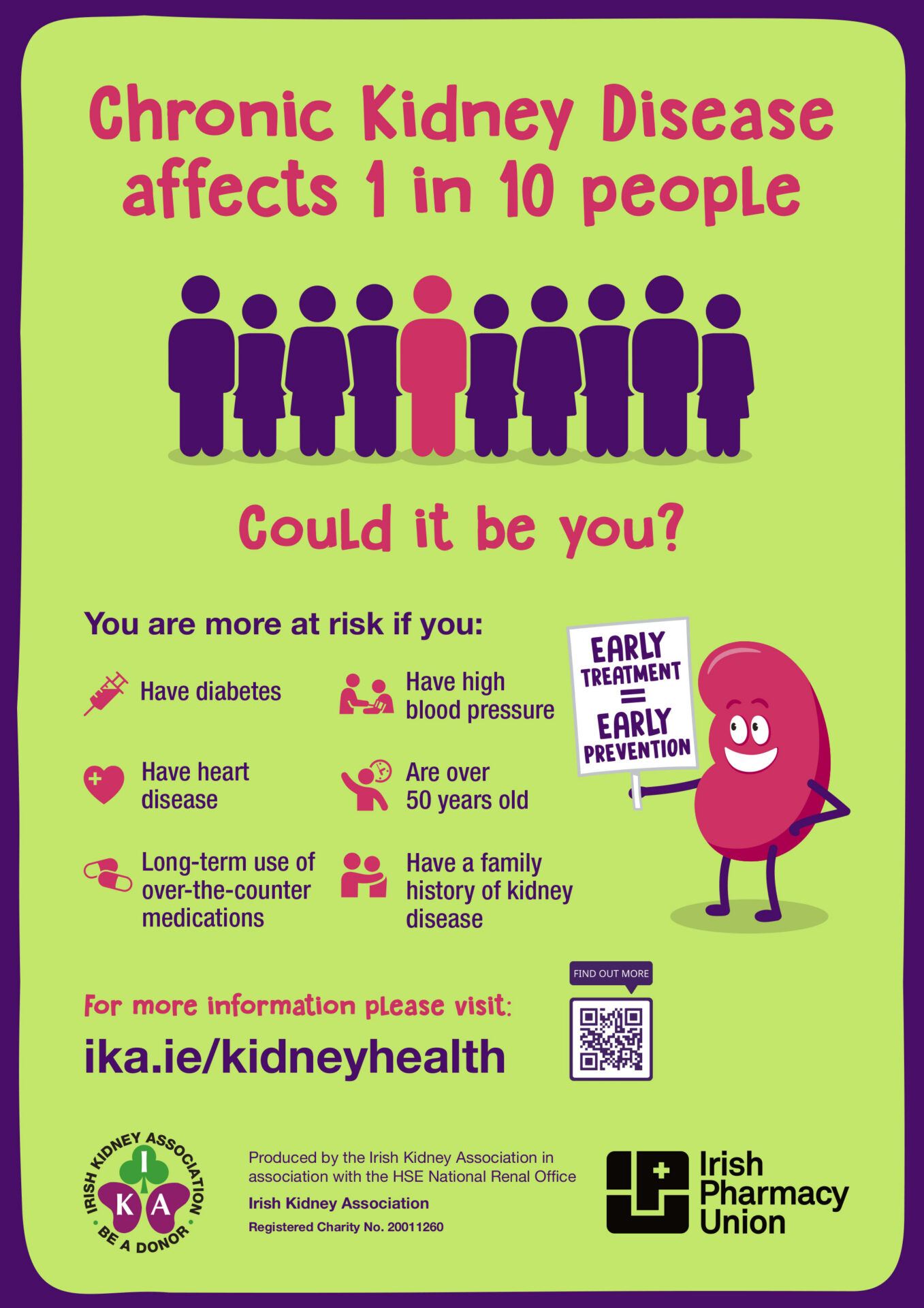 The IPU is pleased to support the Irish Kidney Association’s kidney health awareness campaign to mark World Kidney Day, on 12 March. Included in the March issue of the IPU Review is an A4 poster highlighting the prevalence of chronic kidney disease and its key risk factors.
The poster for display, along with digital screen versions, patient information leaflets and social media assets, is available to download at the ika.ie/kidneyhealth. Representatives from the IKA will also host an information table at the IPU National Pharmacy Conference on 9 May in The Mount Wolseley Hotel, Carlow.
The IPU is pleased to support the Irish Kidney Association’s kidney health awareness campaign to mark World Kidney Day, on 12 March. Included in the March issue of the IPU Review is an A4 poster highlighting the prevalence of chronic kidney disease and its key risk factors.
The poster for display, along with digital screen versions, patient information leaflets and social media assets, is available to download at the ika.ie/kidneyhealth. Representatives from the IKA will also host an information table at the IPU National Pharmacy Conference on 9 May in The Mount Wolseley Hotel, Carlow.