



First published in 2015, the original Framework was developed in response to one of the key recommendations from the NCCP Oncology Medication Safety Review Report (2014), which stated that “National competencies for all disciplines in relation to acute oncology should be developed in collaboration with the relevant colleges and professional bodies”.
The role of pharmacists in the delivery of cancer care has changed significantly in Ireland over recent years. These changes are largely due to increases in the use of systemic anti-cancer therapy (SACT) as a result of the ageing population, and supportive therapy for the management of side effects and co-morbidities. In addition, there has been a significant increase in the use of oral anti-cancer medicines (OAM) which are dispensed to patients in the community. Also, SACT in many cases has become more complex, and digital technology advancements are changing the way in which care is provided. Consequently, the skill and knowledge requirements of pharmacists involved in the delivery of cancer care, in both hospitals and communities, have changed and progressed.
The National Competency Framework for Pharmacists Providing Cancer Care has been comprehensively reviewed and updated to ensure it remains fit-for-purpose, future-focused, and responsive to the changing landscape of cancer care.
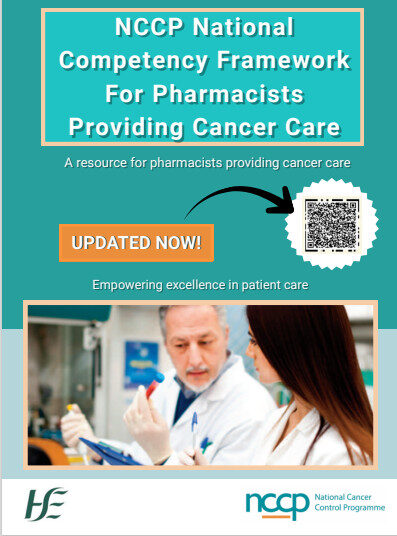
Now aligned to the PSI Core Competency Framework for Pharmacists 2022, the updated NCCP National Competency Framework for Pharmacists Providing Cancer Care also contains five domains: personal, professional, organisation and management skills, pharmacy care and public health. Each of the five domains has several competencies presented. Indicators pertaining to knowledge, skills and behaviours have been assigned within each domain. The indicators are applicable irrespective of the care setting or the staff grade.
In the NCCP National Competency Framework, three levels of practice have been adopted for pharmacists providing cancer care: Generalist, Specialist and Advanced. The first level of practice is defined as Generalist and consists of specific behaviours essential for any pharmacist providing cancer care, including both hospital pharmacists and community pharmacists. Pharmacists at this level will have a basic level of understanding of the principles involved in the prevention, diagnosis and treatment of common cancers. In a hospital setting, these pharmacists would typically be working under the guidance of a more experienced oncology pharmacist and may not necessarily wish to specialise further as oncology pharmacists themselves. The goal is to define a minimum level of competence for any pharmacist having an oncology clinical input.
The three levels in the competency Framework are not necessarily discrete. Each level builds on the previous, creating a wider viewpoint at each stage. Pharmacists mapping their practice will find themselves operating across several levels. This facilitates the formulation of professional development plans. As such, this competency Framework can be used at an individual level to measure performance and to help pharmacists providing cancer care, through reflection, to identify gaps in their continuing professional development needs.
This updated National Competency Framework recognises the role of the pharmacist right across the cancer care continuum, and includes competencies relating to health promotion and education, treatment and survivorship. The Framework hopes to inform the development of pharmacists providing cancer care. In addition, it aims to enhance the quality, safety and efficiency of cancer care provided by pharmacists to improve outcomes for patients with cancer by illustrating the behaviours, skills and knowledge pharmacists require for providing cancer care. The Framework also recognises the importance of open disclosure and transparency in communication with patients.
Work on the updated Framework was led by a specially convened NCCP Working Group, made up of pharmacists from both hospital and community settings, patient representatives, and key stakeholders included IIOP, the IPU, The Irish Pharmacy Haematology Oncology Society and The NCCP Hospital Pharmacist Leads Group.
The NCCP would like to thank all involved for their contributions and commitment.
The updated Framework is also pivotal to ongoing work on the IIOP Cancer Care Hub, which is available at iiop.ie > Resource Hub > Cancer Care Hub.