
- About Us
- News & Publications
- IPU Jobs
- Practice & Support
-
- Safe Pharmacy
-
-
-
Safe Pharmacy | Get Help
Safe Place | Safe phone

-
-
- Professional Academy
- Membership

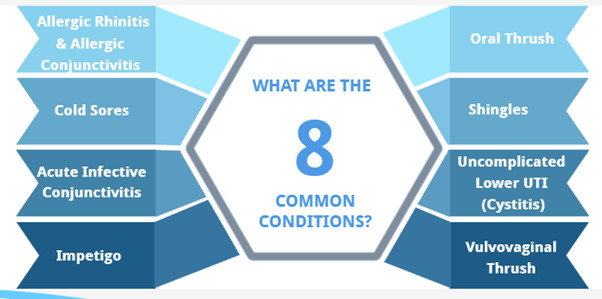
The Common Conditions Service enables community pharmacists to assess, advise, and treat patients presenting with specified common conditions — allergic rhinitis, cold sores, conjunctivitis (acute infective and allergic), impetigo, oral thrush, shingles, uncomplicated lower urinary tract infection and vulvovaginal thrush. Pharmacies offering the service must do so for all eight conditions.
Image 1: What are the eight common conditions?
The service is delivered in accordance with legislation, the PSI’s Guidelines to Support the Provision of a Common Conditions Service and HSE clinical protocols for the service, which have been approved by the Minister for Health. This provides a structure for service delivery and associated data collection that supports consistency across pharmacies. In addition, all pharmacies offering the service must utilise uniform branding and nomenclature to ensure standardisation and identity of the service — Common Conditions Service.
Pharmacists wishing to deliver the service must complete the Irish Institute of Pharmacy (IIOP) CCS training as mandated by the PSI. This training, which is available on the IIOP website, consists of a core regulatory module and eight common condition specific modules, all of which must be successfully completed before the pharmacist can deliver the service and issue associated prescriptions.
The Common Conditions Service Protocols (CCSP) are protocols that have been developed by the HSE Clinical Sub-Group to support the delivery of an Expanded Role for Community Pharmacy and approved by the Minister for Health for use in the CCS. They can be accessed via the CCS webpage on the HSE website (available at hse.ie/eng/about/who/gmscontracts/ccs). The service must be delivered in accordance with the relevant protocol(s). As protocols can be updated over time, pharmacies should ensure they have a process in place to ensure they are working from the most up-to-date-version of the relevant protocol.
The HSE CCS webpage also contains links to an operational guidance document (Operational Guidance for Pharmacists and Pharmacies Delivering the Common Conditions Service (CCS)) and associated Frequently Asked Questions.
To further support pharmacists and pharmacies in implementing and delivering the service we have developed a range of IPU resources. These can all be found on the IPU CCS hub on the IPU website (ipu.ie > Professional > Common Conditions Service).
IPU Standard Operating Procedures: We have developed three Standard Operating Procedures (SOPs):
As SOPs should be tailored to reflect processes in your pharmacy, these SOPs are provided in an editable format to allow relevant changes to be made in-line with local practice in the pharmacy.
IPU Pharmacist Assessment Forms: To support the delivery of a clinical consultation aligned to the HSE Protocols we have developed a series of Pharmacist Assessment Forms (PAFs). These forms contain all the core fields included in the national Consultation Record Form template (available in the national Operational Guidance for Pharmacists and Pharmacies Delivering the Common Conditions Service (CCS)), as well as additional questions and prompts to support with patient assessment, documentation of consent and determination of consultation outcome.
IPU Common Conditions Service Prescription template: To support with standardisation of prescriptions issued under the service we have developed a prescription template. This template captures the required fields that must be included as per legislation as well as additional fields that support with best practice in prescription presentation. These templates can be adapted locally, but pharmacists should ensure that any prescriptions issued adhere to all relevant legislative requirements.
IPU Operational Guidance webinar: This on-demand webinar provides an overview in relation to key operational elements of the service as well as further information in relation to the SOPs, PAFs and prescription template.
At the time of writing, the official launch of national communication in relation to the CCS is scheduled for the week commencing 19 January. The Department of Health will lead out on a Government of Ireland campaign designed to raise awareness of the service. The Department of Health and HSE websites will be updated with key information for the public and the HSE Pharmacy Finder for the CCS, which lists all pharmacies offering the service, will go live.
The IPU CCS media campaign will launch after the Government of Ireland campaign has commenced. It will build on the IPU Medicines Experts campaign, which ran in late 2025 and will highlight that the service is available in pharmacies nationwide. Campaign materials will be shared with members for local use.
Pharmacies wishing to access the official CCS logos and associated guidance on use of the logos can do so via the HSE CCS webpage or the IPU CCS hub on ipu.ie.
A national evaluation of the CCS will be conducted with the help of 150 ‘Data Champion’ pharmacies who will be selected from the group who, through the CCS Opt-in Form, expressed an interest in collecting and returning data for the purposes of service evaluation. A minimum data set to evaluate the Common Conditions Service and determine its long-term impact has been developed and both the IOG developed Consultation Record Form and the IPU PAFs have been designed to facilitate data capture in-line with this data set. The views of patients accessing the service and pharmacists delivering the service will also be sought. Key outcomes that will be analysed include access to care, healthcare utilisation, patient experience, guideline concordance and antimicrobial stewardship.
The CCS represents a landmark advancement in community pharmacy practice, harnessing the expertise and accessibility of community pharmacists to deliver timely, effective treatment for common conditions. As the service evolves, pharmacists are encouraged to engage actively with training opportunities and share feedback. The IPU will continue to advocate for continuous improvement and together we can ensure that the CCS fulfils its potential — enhancing patient care, supporting system efficiency, and contributing to the ongoing transformation of healthcare in Ireland.