


Human health and the environment we live in are closely linked and increasingly threatened by the triple planetary crisis of climate change, biodiversity loss and pollution. In response, the Irish Government committed to halving emissions by 2030 and achieving net zero by 2050 through its Climate Action Plan, with the HSE aligning through its Climate Action Strategy 2023–2050 to embed sustainability into routine care delivery. However, little is known about how primary healthcare professionals perceive their role in delivering these ambitions within Ireland’s existing care models, which have evolved incrementally rather than being intentionally designed with sustainability as a priority.
A recent study, led by Stephen James Walsh MPSI under the supervision of Dr Matthew Lynch MPSI and Dr Aisling O’Leary MPSI, and published in BMJ Open Quality, explored how community pharmacists, dentists, GPs and practice nurses in Ireland perceive climate change and environmentally sustainable healthcare. The study captured real world experiences across primary care, highlighting both practical opportunities for action and the challenges of implementing sustainable healthcare within everyday practice.
Analysis of the interviews generated diverse insights into participants’ experiences, perceptions and behaviours related to sustainable healthcare. To aid interpretation, these were organised into three higher order categories reflecting both current practice and the processes needed for change. Together, the categories describe a progression from understanding and awareness, to initiating meaningful action, and ultimately embedding sustainability as a routine and enduring element of primary healthcare delivery, as shown in Figure 1.
Figure 1: Breakdown of higher order categories and associated categories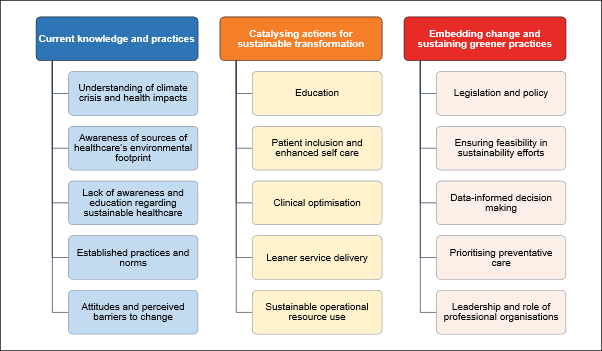
Collectively, the findings show that while primary care professionals are strongly motivated to address climate change, many are unable to translate this intent into routine practice due to a lack of accessible guidance and tools. This highlights a need to move beyond reliance on individual motivation towards a coordinated public health response in Ireland, supported by education, policy, incentivisation and practical interventions that embed environmental sustainability into routine care.
The important role of community pharmacists: Community pharmacists are uniquely positioned to influence medicines management and patient care, which account for a substantial share of healthcare’s environmental impact. Supporting pharmacists to optimise therapy, reduce unnecessary or low value care, and where appropriate consider lower environmental impact alternatives can deliver benefits for both patients and the environment. However, pharmacists emphasised that for these actions to be widely adopted, interventions must be practical, financially supported and easily integrated into existing workflows, rather than adding further administrative burden.
Unused and expired household medicines waste: Pharmacists highlighted the scale of unused and expired medicines generated in the community and the lack of coordinated efforts to reduce medicines waste generation. The introduction of a funded medicines disposal scheme announced in the Community Pharmacy Agreement 2025 is a welcome development, recognising the role of community pharmacy in environmentally responsible medicines management. However, clarity is needed on which hazardous waste streams will be funded for disposal, particularly whether sharps and injectables will be included, or whether clear public signposting will be provided where pharmacy collection for sharps and injectables is not funded. Close monitoring of implementation will be essential to ensure the scheme delivers value for money and achieves its intended environmental and public health benefits.
The role of leadership and guidance in enabling sustainable practice: Pharmacists emphasised that sustainability initiatives are more likely to be adopted when guidance is practical, tailored to the Irish community pharmacy sector, and prioritised across professional and healthcare organisations. Leadership from these bodies is therefore critical to provide legitimacy, set priorities and support consistent action within routine practice. Without such coordinated direction, well intentioned environmental efforts risk remaining fragmented rather than embedded as part of standard care delivery.
This study offers early insights into how practical, tailored guidance for environmentally sustainable community pharmacy practice in Ireland can be developed. Building on these findings, together with insights from a recent national survey of community pharmacists that received strong engagement, work is now underway to pilot concrete environmental sustainability actions in real world community pharmacy settings, supporting a shift from awareness to implementation.
Community pharmacists are invited to participate in this next phase and provide feedback on what works in practice, what does not, and where barriers remain. To express interest in taking part, please contact stephenjwalsh@rcsi.ie.
The authors would like to sincerely acknowledge and thank the healthcare professionals who generously gave their time to participate in this study. Their insights and experiences were invaluable to the research and to the development of future sustainability initiatives in practice.
References available on request.
About the author: Stephen James Walsh is a community pharmacist whose experience in both support and supervising roles, combined with advanced qualifications in Health Policy and Management, has led him to undertake a PhD in environmentally sustainable pharmacy practice, applying his insight and expertise to drive meaningful improvements in the profession.