

- About Us
- News & Publications
- IPU Jobs
- Practice & Support
-
- Safe Pharmacy
-
-
-
Safe Pharmacy | Get Help
Safe Place | Safe phone

-
-
- Professional Academy
- Membership

On 23 October, the Health Information and Quality Authority (HIQA) hosted the conference, ‘Our Healthcare System, Our Voices: An Evidence-Based Approach for Healthcare’, at the Ashling Hotel in Dublin. Over 200 participants attended in person and online.
The conference highlighted the growing role of evidence-based approaches in shaping healthcare, with particular emphasis on clinical guideline development and Health Technology Assessments (HTA). As Ireland’s health system faces increasing demands, HTAs have become a key tool for ensuring that new technologies and treatments deliver both clinical benefit and value for money. A key part of this process, emphasised during the event, is recognising the importance of involving patients and stakeholders in these decisions.
Opening the conference, Dr. Colm Henry, HSE Chief Clinical Officer took attendees through the evolution of clinical practice in Ireland. From an era of fewer guidelines, fewer consultants and experience-driven decisions, we have evolved to an emphasis on standardisation and value-based healthcare. He stressed that modern healthcare is about, “working with, not talking at patients” highlighting the shift toward collaborative decision-making and patient involvement in guideline development.
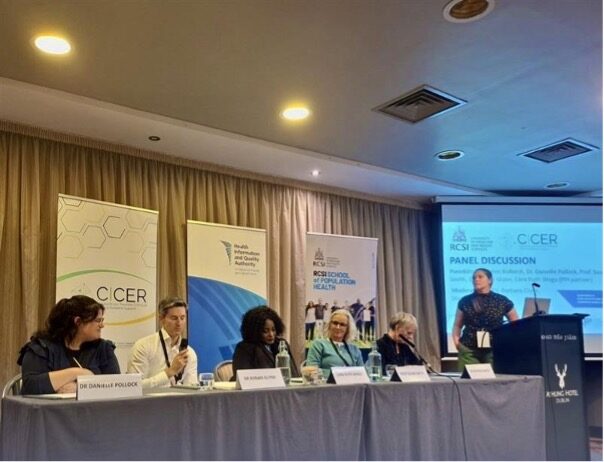 Image 1: Panel discussion featuring Dr. Danielle Pollock, Research Methodologist, Health Evidence Synthesis Recommendations and Impact; Dr. Ronan Glynn, Former Deputy Chief Medical Officer, Department of Health; Lora Ruth Wogu, CEO, European Sickle Cell Federation; Dr. Susan Smith, Clinical Lead, CICER; and Dr. Helen Bulbeck, Director of Policy and Services, Brainstrust.
Health Technology Assessments allows the healthcare system to determine how to best invest in treatments and technologies. Dr. Mary Horgan, Chief Medical Officer at the Department of Health, reinforced how policy decisions should be based on evidence, science and value for money. She highlighted that patient involvement throughout this process is key and reminds us that we will all rely on the healthcare system at some point in our lives. Equally important is the increasing need to seek out patients who do not have a voice and ensure that they are a part of the conversation.
Keynote speaker Dr. Danielle Pollock, a lived experience researcher and methodologist, spoke on the concept of lived-experience research. She drilled home the message that, “people are more than their worst moments, more than one role”. Through her experience in designing resources to support patient involvement in research, Dr. Pollack illustrated how patient perspectives can shape research and produce improved and meaningful outcomes. Dr. Helen Bulbeck, Director of Policy and Services at Brainstrust, reiterated this message by pointing to the evidence-practice gap that can often be seen in research. This is where research priorities diverge from patient needs. She provided an example through osteoarthritis treatment, in which patients expressed greater interest in surgical treatment options, yet research overwhelmingly focused on medication. Her closing remark was a simple but powerful reminder of meaningful patient engagement; “Put the kettle on and say thank you” — a call to action to keep patient involvement grounded in respect and true connection.
A recurring theme was the role of Expert Advisory Groups (EAGs). These multidisciplinary panels, convened by HIQA, bring together healthcare professionals, researchers, and patient representatives to guide the development of clinical guidelines and HTAs. EAG members support the HIQA Evaluation Team during the assessment by providing guidance as appropriate to their area of knowledge. Activities may involve reviewing draft materials to ensure correct data, interpretation and readability. EAGs ensure that diverse perspectives inform decisions, providing both technical evidence and lived experience. Interactive sessions led by Dr Barbara Clyne, Senior Lecturer at the RCSI, invited attendees to share what HIQA should start, stop, and continue doing to help stakeholders navigate the EAG process while maintaining clarity and accessibility.

Image 2: Angela Fitzgerald, HIQA CEO, delivering the final address.
The panel discussion featured Dr. Danielle Pollock and Dr. Helen Bulbeck as well as Lora Ruth Wogu, CEO of the European Sickle Cell Federation; Dr. Susan Smith, Clinical Lead, CICER; and Dr. Ronan Glynn, Former Deputy Chief Medical Officer at the Department of Health. On being asked their goals for the future of clinical guideline development in Ireland, panellists discussed the need for more open conversation on patient collaboration, in addition to “living guidelines”, stronger patient partnerships, and the possibility of embedding PPI in national policy.
HIQA announced plans at the event to release online learning materials for clinical guideline stakeholders, early next year. Updated guidelines for stakeholder engagement in HTA will undergo public consultation before their release in 2026, aligning with upcoming European HTA regulations.
Closing the event, Angela Fitzgerald, CEO of HIQA, reinforced the central message: patient involvement is vital to developing clinical guidelines that offer efficient and consistent care. Her words captured the essence of evidence-based care, where it is vital to “give facts, not feelings”. For pharmacy professionals, these developments signal a growing role in applying HTA principles and supporting patient engagement, ensuring that decisions reflect both scientific evidence and lived patient experience.
The IPU has been invited by HIQA to represent the views of community pharmacists on several Expert Advisory Groups (EAGs) convened for Health Technology Assessments (HTA).
There have been several HTAs carried out within the area of vaccination in recent years. Susan O’Donnell MPSI, Professional Services Pharmacist, represented the IPU on the EAGs for a number of HTAs, including:
The IPU also make submissions where appropriate as part of the public consultation stage.